The rise of the Schutzstaffel (SS) was one of the most significant developments in the history of Nazi Germany. Founded on 9 November 1925 as a small unit responsible for protecting Adolf Hitler and senior members of the Nazi Party, the SS gradually evolved into a vast organisation controlling Germany's police, intelligence services, concentration camps and many of the institutions responsible for carrying out the Holocaust.
Unlike the Beer Hall Putsch or the Night of the Long Knives, the rise of the SS was not a single event but a carefully orchestrated expansion of power that unfolded over two decades. Under the leadership of Heinrich Himmler, the organisation absorbed one institution after another, eventually becoming the most powerful instrument of terror within the Third Reich. By the outbreak of the Second World War, its influence reached into almost every aspect of German society.
Understanding how the SS developed is essential to understanding the Nazi dictatorship itself. From the surveillance of political opponents to the administration of concentration camps, from the Gestapo and the Security Service (SD) to the Einsatzgruppen and the extermination camps, the SS became the organisation through which Adolf Hitler transformed ideology into state policy and mass murder.
This page follows that transformation from its modest beginnings in 1925 to its central role in the Holocaust and its eventual destruction after the collapse of Nazi Germany in 1945.
Why was the SS created?
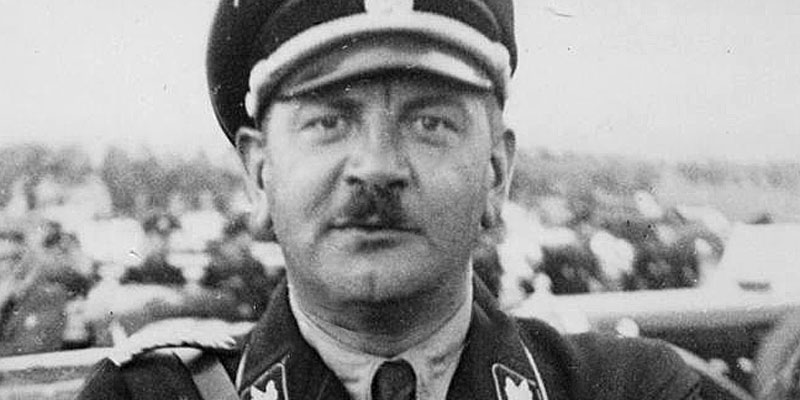
The origins of the SS can be traced to the Stoßtrupp Adolf Hitler, established in 1923 as a small bodyguard unit responsible for the personal protection of Adolf Hitler and the leadership of the Nazi Party. Following the failure of the Beer Hall Putsch on 8-9 November 1923 and Hitler's imprisonment, the unit was disbanded. After his release, Hitler founded the Schutzstaffel (SS) on 9 November 1925, building upon the concept of a small, disciplined and personally loyal bodyguard. The organisation initially consisted of fewer than 300 members and remained subordinate to the SA. Its first leader was Julius Schreck, one of Hitler's earliest supporters and a participant in the Beer Hall Putsch.
During its first years, the SS remained largely unnoticed. Its members provided security at Nazi Party meetings, guarded senior officials during public appearances and acted as Hitler's personal bodyguards. Although tiny compared with the rapidly expanding SA, the SS developed a reputation for discipline, loyalty and absolute obedience, qualities that would later distinguish it from every other Nazi organisation.
What began as a small personal bodyguard would eventually become the organisation that controlled Germany's police, intelligence services, concentration camps and much of the machinery responsible for the Holocaust. Few organisations in modern history have undergone such a dramatic transformation in so short a time.
Heinrich Himmler takes command
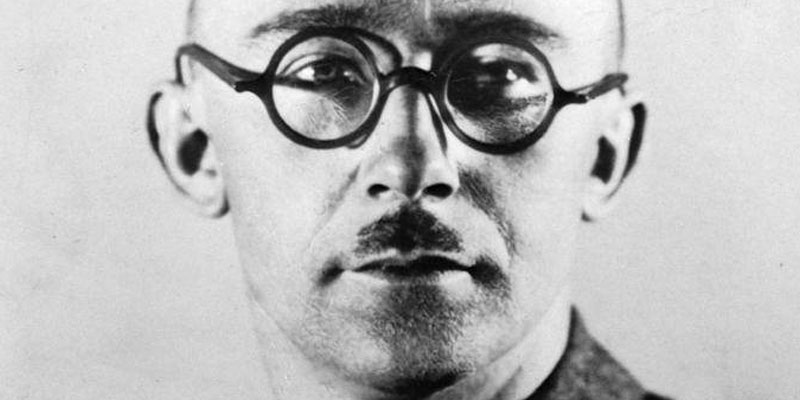
The future of the SS changed dramatically on 6 January 1929, when Heinrich Himmler was appointed Reichsführer-SS. At the time, the organisation remained small and largely overshadowed by Ernst Röhm's rapidly expanding SA. Himmler, however, had ambitions that reached far beyond providing personal protection for Adolf Hitler.
He envisioned the SS as an elite ideological order whose members would demonstrate complete loyalty to Hitler and unwavering commitment to National Socialist ideals. Recruitment standards became increasingly strict, with applicants subjected to political, racial and physical screening. Himmler believed that discipline, organisation and ideological commitment would ultimately prove more valuable than sheer numbers.
Over the following years, the SS slowly expanded while remaining in the shadow of the SA. Few observers realised that Himmler was quietly building the foundations of an organisation that would eventually dominate Germany's entire security apparatus.
The Sicherheitsdienst (SD)
The appointment of Heinrich Himmler in 1929 marked the beginning of the SS's expansion, but its true transformation began two years later. Himmler understood that power could not be maintained through force alone. To protect the Nazi Party and eliminate its enemies, he needed an organisation capable of gathering intelligence, identifying political opponents and monitoring every aspect of German society.
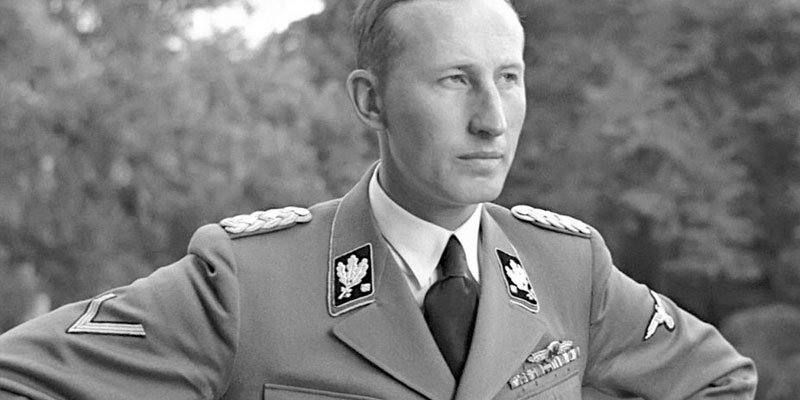
On 4 September 1931, Himmler issued a secret directive and established the Sicherheitsdienst (SD) and appointed the young former naval officer Reinhard Heydrich to lead the new intelligence service. Although Heydrich had no previous experience in intelligence work, he quickly proved to be one of the most capable and ruthless administrators within the Nazi hierarchy.
The SD initially focused on collecting information about political opponents, rival organisations and individuals considered hostile to National Socialism. Its agents compiled extensive files on politicians, religious leaders, trade unionists and even members of the Nazi Party itself. By rewarding loyalty and exposing dissent, the SD rapidly became one of Himmler's most powerful tools.
Unlike the SA, which relied on public displays of violence and intimidation, the SD operated largely in secret. Intelligence gathering, surveillance and infiltration became its principal weapons. This combination of bureaucracy and terror would later define much of the SS's methods throughout the Third Reich.
As Hitler's political influence increased, so did the responsibilities of the SD. After the Nazi seizure of power in January 1933, the organisation expanded rapidly alongside the SS. Information gathered by Heydrich's agents increasingly influenced arrests, interrogations and the identification of individuals regarded as enemies of the regime.
The creation of the SD fundamentally changed the character of the SS. What had begun as Hitler's personal bodyguard was evolving into an organisation that relied not only on force, but also on intelligence, surveillance and political control.
The road to absolute power
Between 1933 and 1934, the SS expanded at an extraordinary pace. While the SA under Ernst Röhm continued to grow into a paramilitary force numbering more than three million men, Himmler concentrated on building a smaller, disciplined organisation whose loyalty rested entirely with Adolf Hitler.
The relationship between the two organisations became increasingly strained. Röhm believed the SA should replace the traditional German Army and lead what he described as a "Second Revolution" to reshape German society. His ambitions alarmed conservative politicians, senior military officers and industrial leaders, all of whom feared the growing power of the SA.
For Himmler and Heydrich, the crisis presented an opportunity. Together they supplied Hitler with intelligence suggesting that Röhm and the SA leadership posed a threat to the stability of the regime. Whether these reports reflected genuine concerns or were deliberately exaggerated remains the subject of historical debate, but they played a significant role in convincing Hitler to act.
By the summer of 1934, the foundations had been laid for the event that would permanently transform the balance of power within Nazi Germany.
The rivalry between the SA and the SS was no longer simply a struggle for influence within the Nazi Party. It had become a battle over who would control the future of Hitler's dictatorship.
The Night of the Long Knives
The greatest turning point in the rise of the SS came during the Night of the Long Knives, which took place between 30 June and 2 July 1934. By this time, the Sturmabteilung (SA), led by Ernst Röhm, had grown into a force of more than three million men. Röhm's ambition to replace the German Army and launch a so-called "Second Revolution" alarmed both Adolf Hitler and Germany's military leadership.
Supported by Heinrich Himmler, Reinhard Heydrich, Hermann Göring and the SS leadership, Hitler ordered a nationwide purge of the SA leadership and numerous political opponents. Röhm and many of his closest associates were arrested at the Hanselbauer Hotel in Bad Wiessee. He was later executed at Stadelheim Prison by Theodor Eicke and Michael Lippert. During the purge, many others, including former Chancellor Kurt von Schleicher and Munich Police Chief August Schneidhuber, were also murdered.
The operation eliminated the only organisation within the Nazi Party capable of challenging Hitler's authority. It also destroyed the political influence of the SA almost overnight. While Röhm's organisation survived as a greatly reduced auxiliary force, the SS emerged as Hitler's most trusted instrument of power.
On 20 July 1934, only weeks after the purge, the SS officially became an independent organisation, answering directly to Adolf Hitler rather than remaining subordinate to the SA. For Heinrich Himmler, this marked the beginning of an extraordinary expansion of authority that would continue throughout the Third Reich.
The destruction of the SA fundamentally changed the balance of power within Nazi Germany. By eliminating Ernst Röhm, Adolf Hitler removed the only organisation capable of challenging his authority from within the Nazi Party. The SS emerged from the purge not simply as a victorious organisation, but as the regime's most trusted instrument of terror.
Explore the Night of the Long Knives
The creation of the Waffen-SS
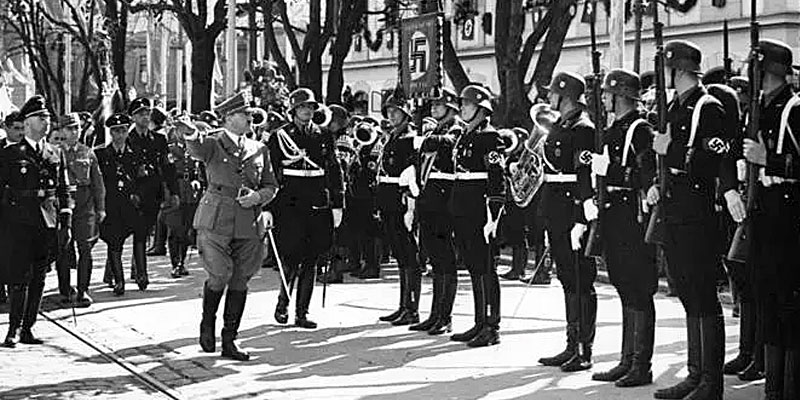
Although the SS is often associated with combat units, its primary role remained political control, policing and internal security. The organisation was divided into several branches. The Allgemeine-SS (General SS) supervised ideological training, the police, the Gestapo, the Sicherheitsdienst (SD) and the concentration camp system, while the military formations gradually evolved into the Waffen-SS.
The Waffen-SS originated from small armed SS units responsible for protecting Adolf Hitler and key Nazi leaders. During the late 1930s these formations expanded into fully equipped combat divisions that fought alongside the German Army during the Second World War. Although they served as frontline troops, they remained under the authority of the SS and were separate from the regular Wehrmacht.
The rise of the Waffen-SS did not replace the Allgemeine-SS. Both branches expanded simultaneously, with one enforcing Nazi rule behind the front lines while the other carried that ideology onto the battlefield.
The concentration camp system
The SS rapidly expanded its authority following the Night of the Long Knives. One of its most significant new responsibilities became the administration of Germany's growing network of concentration camps. Although the first camps had already been established after Hitler came to power in 1933, it was the SS that transformed them into a centrally organised system of repression.
A key figure in this development was Theodor Eicke, who became Inspector of Concentration Camps after the purge. Having previously served as commandant of Dachau Concentration Camp, Eicke introduced strict regulations, standardised guard training and brutal disciplinary measures that were gradually implemented throughout the camp system.
SS-Totenkopfverbände
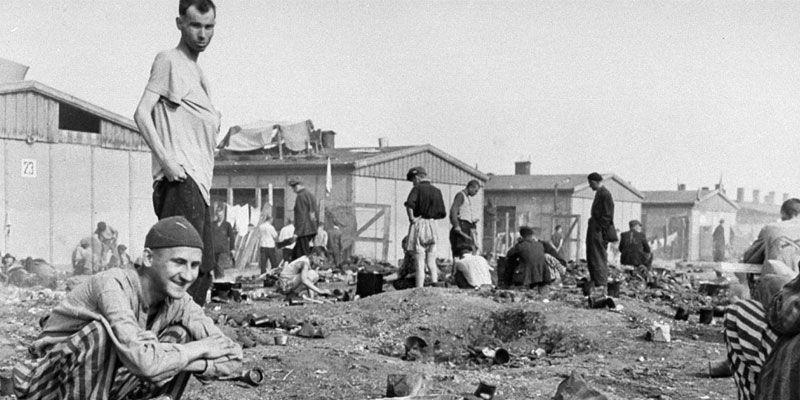
He also organised the camp guards into the SS-Totenkopfverbände (Death's Head Units), whose members wore the distinctive Totenkopf (skull) insignia and were responsible for guarding and administering the concentration camps. Eicke's methods became the blueprint for nearly every SS-run concentration camp established before and during the Second World War. Under SS control, the camps evolved from prisons for political opponents into instruments of persecution targeting Jews, Roma and Sinti, Jehovah's Witnesses, homosexuals, clergy, resistance members and countless others considered enemies of the Nazi regime. As Germany expanded across Europe, so too did the concentration camp network.
Dachau became far more than Germany's first permanent concentration camp. Under Theodor Eicke, it developed into the organisational model for the entire SS camp system, shaping the administration and brutality of dozens of camps that followed.
Explore Dachau Concentration Camp
The RSHA and the Holocaust
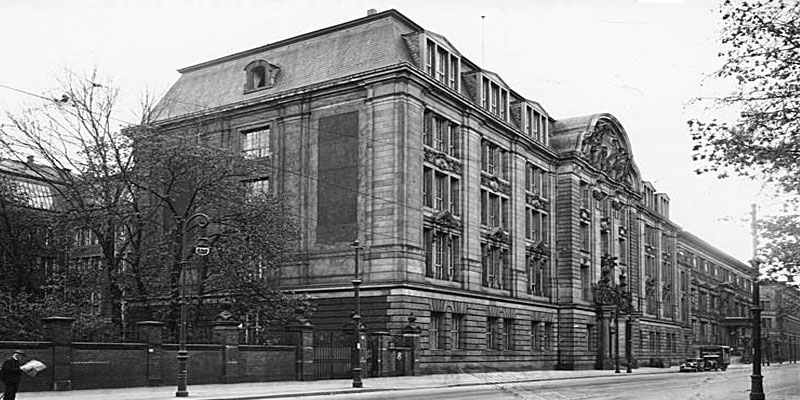
The influence of the SS continued to expand throughout the 1930s. On 27 September 1939, the Reich Main Security Office (RSHA) was created under the leadership of Reinhard Heydrich. The new organisation combined the Security Service (SD), the Gestapo and the Kriminalpolizei (Kripo) into a single administrative structure, giving the SS unprecedented control over Germany's intelligence, policing and internal security.
The outbreak of the Second World War accelerated the SS's growth even further. As German forces occupied much of Europe, the organisation became responsible for implementing Nazi racial policy across the occupied territories. The SS supervised the concentration camp system, organised mass deportations and directed countless acts of persecution against civilians.
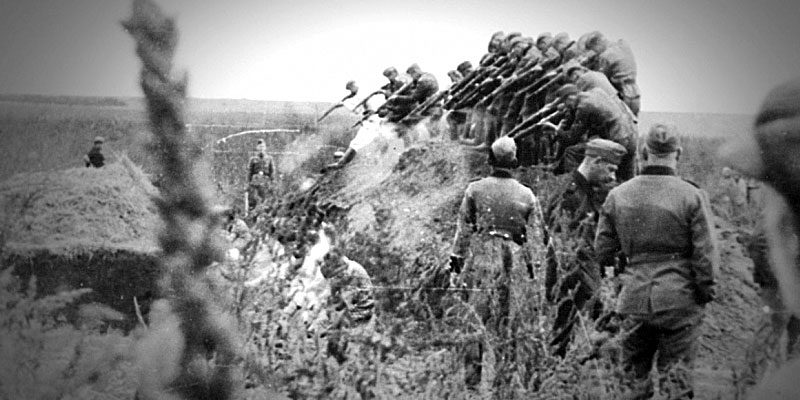
Following the invasion of the Soviet Union in June 1941, specially organised SS and police units known as the Einsatzgruppen followed the advancing German Army. Assisted by the Ordnungspolizei, Waffen-SS units and local collaborators, these mobile killing squads systematically murdered more than one million Jews, political commissars, Roma and Sinti, and many other civilians in what later became known as the "Holocaust by bullets".
At the same time, the SS expanded the concentration camp system into a network that stretched across occupied Europe. Camps such as Auschwitz-Birkenau, Treblinka, Sobibor, Belzec, Chelmno and Majdanek became central to the implementation of the Final Solution, the Nazi plan to systematically murder Europe's Jewish population. Millions of Jews, together with Roma and Sinti, Soviet prisoners of war, disabled people, resistance fighters and countless other victims, were deported to these camps under SS administration.
The rise of the SS reached its terrible conclusion during the Holocaust. What had begun as Adolf Hitler's personal bodyguard evolved into the organisation that planned, coordinated and carried out some of the greatest crimes against humanity in modern history.
The fall of the SS
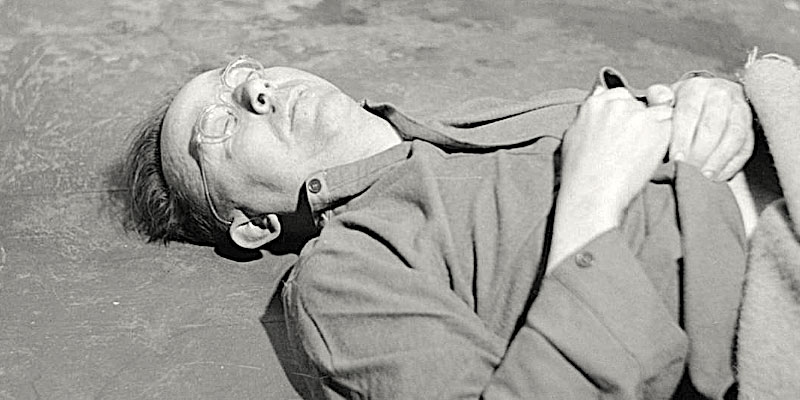
The collapse of Nazi Germany in May 1945 brought an end to the SS. The organisation was dissolved by the Allied powers, and many of its senior leaders were captured or committed suicide. Heinrich Himmler was arrested by British forces but took his own life on 23 May 1945 by biting into a concealed cyanide capsule.
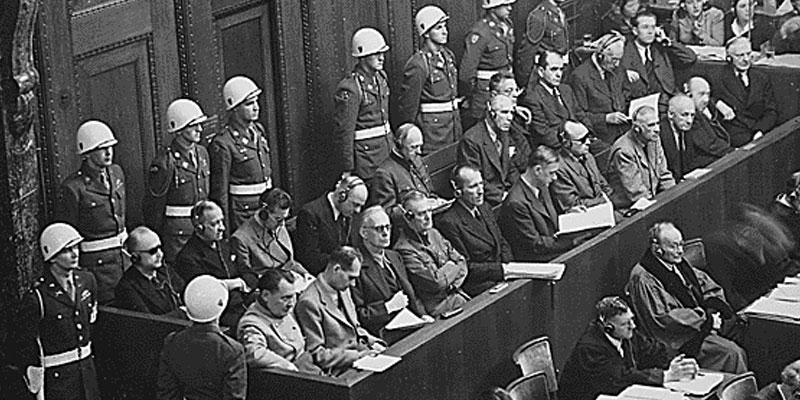
During the Nuremberg Trials, the International Military Tribunal declared the SS to be a criminal organisation because of its central role in war crimes, crimes against humanity and the Holocaust. Numerous SS leaders were later prosecuted in the Subsequent Nuremberg Trials, including the Einsatzgruppen Trial, where commanders of the mobile killing squads were held accountable for the mass murder of civilians across Eastern Europe.
Today, the SS remains one of history's most infamous organisations. Its transformation from a small bodyguard unit into a vast apparatus of terror demonstrates how ideology, bureaucracy and absolute power can combine to produce systematic persecution and genocide on an unprecedented scale.
The history of the SS is not merely the story of one organisation. It is a warning of how unchecked political power, fanaticism and obedience can destroy democratic institutions, erase individual rights and ultimately lead to crimes on an industrial scale.
Principal Figure

in-depth information.