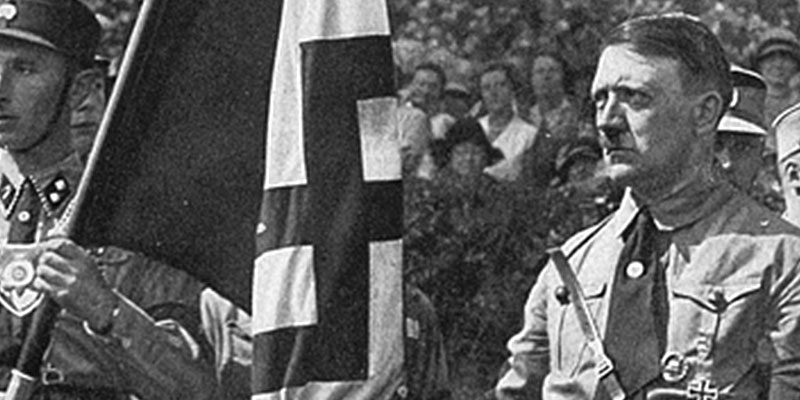
The Beer Hall Putsch, also known as the Munich Putsch, was a failed coup d'état carried out on 8–9 November 1923 by Adolf Hitler, General Erich Ludendorff and members of the National Socialist German Workers' Party (NSDAP). The conspirators attempted to overthrow the Bavarian government in Munich and use the city as the starting point for a national revolution against the Weimar Republic in Berlin.
Inspired by Benito Mussolini's March on Rome in 1922, Hitler believed that Germany's political and economic crisis offered the perfect opportunity to seize power by force. Instead, the uprising collapsed within twenty-four hours after a gun battle with Bavarian police at the Feldherrnhalle. Although the coup failed militarily, it became one of the defining turning points in modern German history. Hitler's subsequent trial gave him national publicity, while his imprisonment convinced him that political power could be achieved more effectively through legal means than through armed revolution.
The Beer Hall Putsch therefore marked the transition of the Nazi Party from a regional extremist movement into a national political force. The lessons Hitler learned during those two days shaped the strategy that eventually brought him to power on 30 January 1933, paving the way for the dictatorship of the Third Reich, the Holocaust and the outbreak of the Second World War.
Quick Facts
Event: Beer Hall Putsch (Munich Putsch)
Date: 8–9 November 1923
Location: Munich, Bavaria, Germany
Participants: Adolf Hitler, Erich Ludendorff, the NSDAP, the SA and nationalist supporters
Objective: Overthrow the Bavarian Government and begin a march on Berlin to topple the Weimar Republic
Result: Failed coup d'état
Casualties: 16 Nazi supporters, 4 Bavarian police officers and 1 civilian killed
Historical significance: Hitler abandoned armed revolution and adopted the Legalitätstaktik ("strategy of legality"), ultimately leading to his appointment as Chancellor in 1933.
Background: Germany After the First World War
Germany emerged from the First World War politically divided, economically exhausted and socially unstable. The Treaty of Versailles, signed on 28 June 1919, imposed severe territorial losses, military restrictions and heavy reparations. Many Germans regarded the treaty as a national humiliation and blamed the new democratic government for accepting its terms.
Nationalist politicians promoted the false Dolchstoßlegende, or "stab-in-the-back myth", claiming that Germany had not been defeated on the battlefield but had instead been betrayed by politicians, socialists and Jews. These politicians became known in nationalist propaganda as the "November Criminals", referring to the leaders who had accepted the armistice in November 1918.
The newly established Weimar Republic struggled to maintain order. Communist uprisings, right-wing coups and political assassinations became increasingly common. Veterans returning from the war joined numerous paramilitary organisations, many of which rejected parliamentary democracy altogether.
Among those attracted to radical nationalism was Adolf Hitler, who joined the German Workers' Party (DAP) in 1919. His exceptional speaking ability quickly transformed him into the party's dominant figure. In 1920, the movement adopted a new name: the National Socialist German Workers' Party (NSDAP), commonly known as the Nazi Party.
Why Bavaria Became the Centre of Right-Wing Extremism
During the early 1920s, Bavaria developed into the heart of Germany's nationalist opposition to the Weimar Republic. Unlike Berlin, where democratic institutions were stronger, Munich became a refuge for monarchists, conservative officers, Freikorps veterans and radical nationalist organisations.
Many influential Bavarian politicians believed the republic was weak and incapable of restoring Germany's former greatness. At the same time, they feared communist revolution even more than right-wing extremism. This political atmosphere allowed nationalist organisations such as the Nazi Party to grow rapidly while receiving sympathetic treatment from sections of the Bavarian military, judiciary and civil service.
The Nazi Party also expanded its own paramilitary organisation, the Sturmabteilung (SA), led by Ernst Röhm. The SA protected Nazi meetings, intimidated political opponents and frequently engaged in violent street battles with communist groups. By 1923, Hitler believed he possessed enough armed supporters to challenge the Bavarian authorities directly.
The Crisis of 1923
Germany's political situation deteriorated dramatically during 1923. In January, French and Belgian troops occupied the Ruhr after Germany failed to meet its reparations obligations. The German government responded by encouraging passive resistance while continuing to print vast quantities of money to pay striking workers.
The result was one of history's worst examples of hyperinflation. The German Mark rapidly became almost worthless. Ordinary families saw their life savings disappear, wages lost value within hours and essential goods became increasingly unaffordable. Economic chaos further undermined confidence in the Weimar Republic and strengthened extremist political movements on both the left and the right.
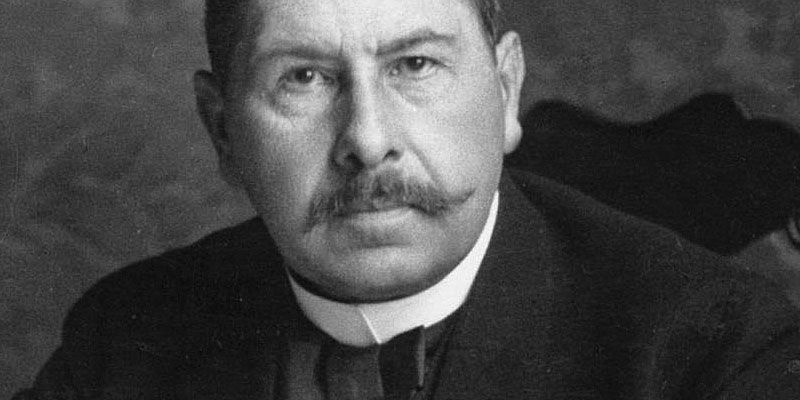
In Bavaria, the crisis prompted the government to declare a state of emergency. On 26 September 1923, Gustav Ritter von Kahr was appointed General State Commissioner with near-dictatorial powers. Together with General Otto von Lossow, commander of the Reichswehr in Bavaria, and Colonel Hans Ritter von Seisser, head of the Bavarian State Police, he formed a powerful ruling triumvirate.
Although all three opposed the Weimar Republic and favoured a stronger nationalist government, they intended to pursue their own conservative agenda rather than support Hitler's revolutionary ambitions. Hitler increasingly feared that Kahr would establish a nationalist dictatorship without involving the Nazi Party.
Planning the Coup
Determined not to be sidelined, Hitler began preparing an armed uprising during the autumn of 1923. His plan closely resembled Mussolini's March on Rome, which had successfully brought the Italian Fascists to power the previous year. Hitler hoped to seize control of Munich, force the Bavarian government to support his revolution and then march north to Berlin.
To strengthen his position, Hitler secured the support of General Erich Ludendorff, one of Germany's most respected military commanders from the First World War. Although Ludendorff played only a limited role in planning the coup, his reputation gave the conspiracy credibility among nationalist circles and military veterans. Hitler believed that soldiers and police officers would hesitate to oppose such a celebrated war hero.
The conspiracy also involved several men who would later become leading figures in Nazi Germany, including Hermann Göring, Rudolf Hess, Heinrich Himmler, Alfred Rosenberg, Ulrich Graf and Max Erwin von Scheubner-Richter. While some played only supporting roles, many would later become prominent members of the Nazi regime.
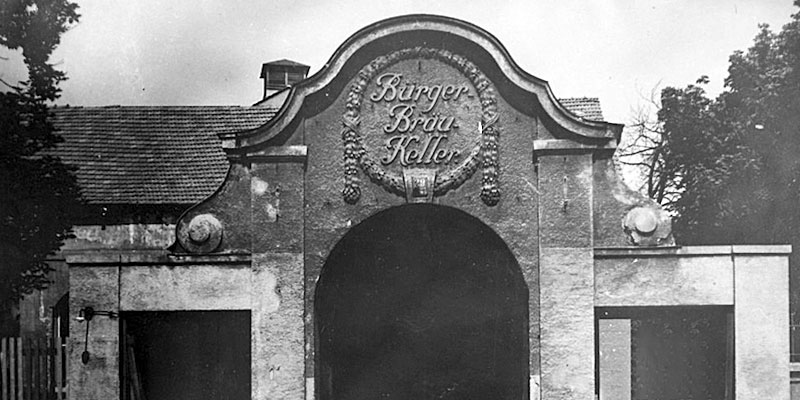
Hitler chose the Bürgerbräukeller, one of Munich's largest beer halls, because it regularly hosted political meetings attended by Bavaria's senior leaders. On the evening of 8 November 1923, Gustav von Kahr was scheduled to address an audience of approximately 3,000 people. Hitler believed this provided the ideal opportunity to seize control of the Bavarian leadership in a single dramatic action.
The Bürgerbräukeller
Shortly after 8.30 p.m. on 8 November 1923, approximately 600 members of the SA surrounded the Bürgerbräukeller and blocked the exits. Armed supporters positioned machine guns outside while Hitler entered the crowded hall accompanied by Hermann Göring and other leading Nazis.
Climbing onto a chair, Hitler fired a pistol shot into the ceiling to silence the audience before announcing that the "national revolution" had begun. He declared that both the Bavarian Government and the Weimar Government had been overthrown and proclaimed the formation of a new national government under his leadership.
Hitler then escorted Gustav von Kahr, Otto von Lossow and Hans Ritter von Seisser into a private room at gunpoint. There, he demanded that they support the coup and accept positions in his proposed government. Although the three men appeared to agree under duress, their apparent support would prove to be one of the greatest misunderstandings of Hitler's political career.
The Fatal Mistake
Although the atmosphere inside the Bürgerbräukeller initially appeared to favour the conspirators, the success of the coup depended entirely on securing the genuine support of Gustav von Kahr, Otto von Lossow and Hans Ritter von Seisser. Hitler believed that once these influential Bavarian leaders publicly endorsed the revolution, the army, police and civil administration would follow.
After addressing the crowd, Hitler temporarily left the beer hall to deal with reports of disturbances elsewhere in Munich. It was one of the most consequential decisions of the entire operation. During his absence, General Erich Ludendorff, convinced that German officers would honour their word, allowed Kahr, Lossow and Seisser to leave without armed escort.
The three men had never intended to support Hitler voluntarily. Once free, they immediately repudiated the promises they had made under duress. Kahr denounced the uprising, Lossow alerted Reichswehr units and Seisser ordered the Bavarian State Police to suppress the coup. Government forces quickly secured military headquarters, public buildings, telephone exchanges and railway stations throughout Munich.
By dawn on 9 November 1923, the attempted revolution had already begun to unravel. Instead of rallying behind Hitler, the Bavarian authorities prepared to confront the putschists by force.
The March on Munich
Despite the collapse of their original plan, Hitler and Ludendorff refused to abandon the uprising. Hoping to regain the initiative, Ludendorff proposed marching through the centre of Munich towards the Bavarian Defence Ministry. He believed that ordinary citizens, soldiers and police officers would join them once they witnessed the presence of Germany's famous wartime commander.
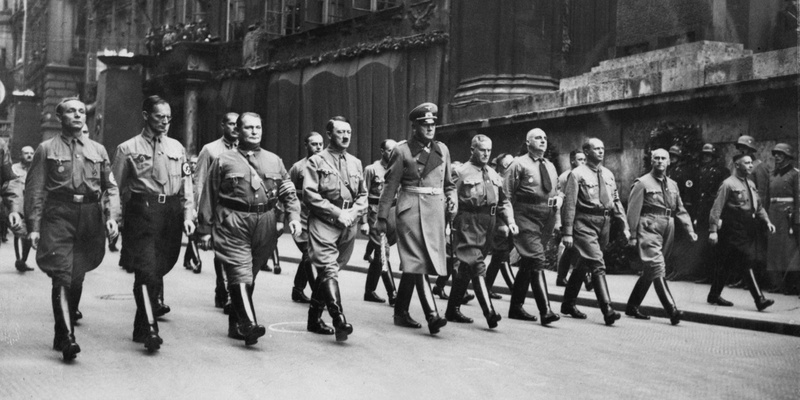
Late in the morning of 9 November 1923, approximately 2,000 supporters assembled in formation. Leading the procession were Adolf Hitler, Erich Ludendorff, Hermann Göring, Ernst Röhm, Ulrich Graf, Max Erwin von Scheubner-Richter and other senior members of the Nazi Party.
Among the marchers was also the twenty-three-year-old Heinrich Himmler. At this stage he remained an obscure party activist with no command authority, yet he proudly carried the Reichskriegsflagge, the Imperial German war flag. Although his role during the putsch was minor, the experience proved formative for the man who would later become Reichsführer-SS and one of the principal architects of the Holocaust.
The column advanced through Munich largely without opposition. Curious citizens gathered along the streets while many onlookers simply watched events unfold. Hitler hoped the march would gather momentum as more supporters joined along the route, but government forces had already organised a defensive response.
The Feldherrnhalle Shootout
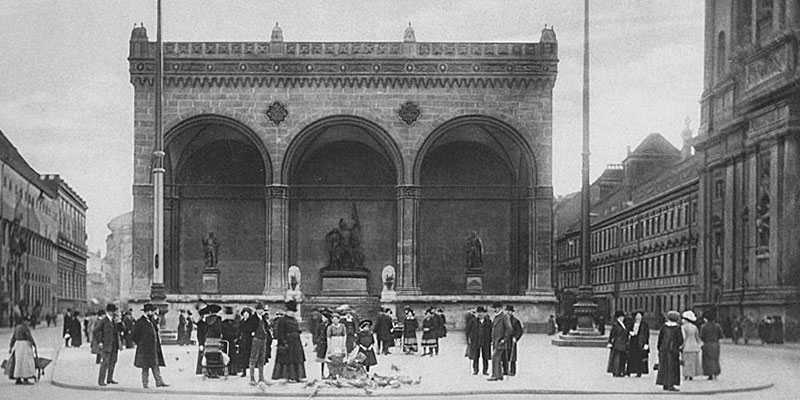
Shortly before midday, the march reached the Odeonsplatz, where approximately 130 Bavarian State Police officers blocked the route near the historic Feldherrnhalle. The officers had received clear orders to prevent the putschists from advancing any further.
Exactly who fired the first shot remains uncertain and continues to be debated by historians. Within seconds, however, both sides exchanged gunfire and the confrontation descended into chaos.
The brief firefight lasted less than one minute but proved decisive. Sixteen Nazi supporters, four Bavarian police officers and one civilian bystander lost their lives. The attempted revolution collapsed almost instantly.
One of the most significant casualties was Max Erwin von Scheubner-Richter, who was walking arm-in-arm with Hitler at the front of the procession. When Scheubner-Richter was struck by a bullet, his falling body pulled Hitler violently to the ground, dislocating Hitler's left shoulder. Hitler later regarded Scheubner-Richter as the only truly irreplaceable loss suffered by the Nazi movement during the putsch.
Ulrich Graf, Hitler's personal bodyguard, threw himself in front of Hitler in an attempt to shield him from the gunfire and was seriously wounded by several bullets. His actions almost certainly saved Hitler's life.
Meanwhile, Hermann Göring suffered severe gunshot wounds to the groin and leg. He managed to escape across the Austrian border, where he received medical treatment. The pain from his injuries eventually contributed to his long-term dependence on morphine.
As bullets echoed across the Odeonsplatz, panic spread among the marchers. Many fled into surrounding streets while others threw themselves to the ground. Within moments, the Beer Hall Putsch had come to an end.
Hitler's Escape and Arrest
Following the collapse of the march, Hitler escaped from the city in a waiting vehicle. He was taken to the country home of Ernst Hanfstaengl in Uffing am Staffelsee, approximately fifty kilometres south of Munich.
The Bavarian authorities immediately launched a manhunt for the conspirators. While many participants were arrested within hours, Hitler remained in hiding for two days before police traced his whereabouts.
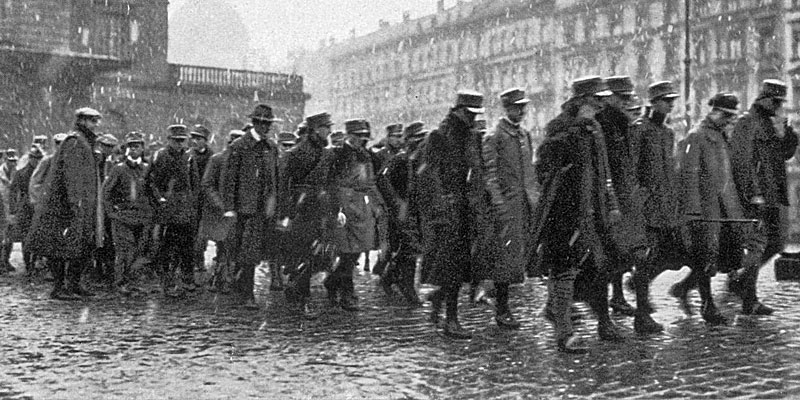
On 11 November 1923, officers surrounded the villa and arrested Hitler without resistance. He was transported back to Munich and formally charged with high treason. The failed coup appeared to have destroyed both his political career and the Nazi Party.
The Blutfahne
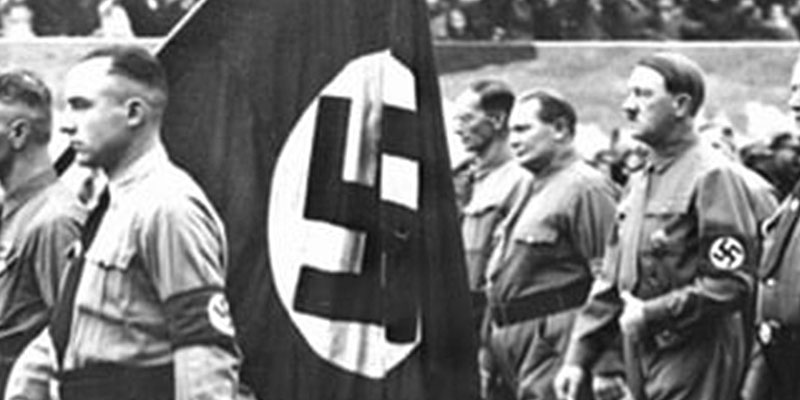
Although the Beer Hall Putsch had failed, the Nazi Party quickly transformed the events at the Feldherrnhalle into a powerful political myth. During the shootout, one of the party's swastika flags became stained with the blood of fallen participants, particularly Andreas Bauriedl, who was carrying the flag when he was killed.
This banner became known as the Blutfahne, or "Blood Flag". After the Nazi Party returned to prominence, Hitler treated it as one of the movement's holiest relics. At annual party rallies in Nuremberg, he used the Blood Flag to ceremonially touch newly created SA and SS standards, symbolically transferring the sacrifice of the party's early "martyrs" to later generations.
The sixteen Nazis killed during the putsch were elevated to almost sacred status within Nazi propaganda. Annual ceremonies held every 9 November celebrated them as heroes who had died for Germany's future.
The date itself became deeply embedded in Nazi symbolism. It was during the annual commemoration of the Beer Hall Putsch on 9 November 1938 that Joseph Goebbels encouraged coordinated anti-Jewish violence following the death of German diplomat Ernst vom Rath. The result was Kristallnacht, linking two of the most significant events in Nazi history through the same symbolic anniversary.
The Trial
Hitler, Ludendorff and eight other leading conspirators appeared before the Munich People's Court between 26 February and 1 April 1924. Instead of ending Hitler's political ambitions, the proceedings became one of the greatest propaganda victories of his career.
Representing himself for much of the trial, Hitler openly admitted organising the coup but denied any criminal intent. He argued that his actions had been motivated by patriotism and that he sought only to save Germany from national collapse. His lengthy speeches received extensive newspaper coverage throughout Germany, introducing millions of Germans to the charismatic Nazi leader for the first time.
The presiding judge, Georg Neithardt, showed considerable sympathy towards the nationalist defendants and allowed Hitler remarkable freedom to turn the courtroom into a political stage. Although the charge of high treason technically carried the possibility of a far harsher punishment, Hitler received the minimum sentence permitted by law.
While Erich Ludendorff was acquitted, Hitler was sentenced on 1 April 1924 to five years of Festungshaft, or fortress confinement. Unlike ordinary imprisonment, fortress confinement was intended for political offenders considered to have acted from honourable motives. Prisoners enjoyed relatively comfortable conditions, were permitted regular visitors and were not required to perform hard labour.
Landsberg Prison and Mein Kampf
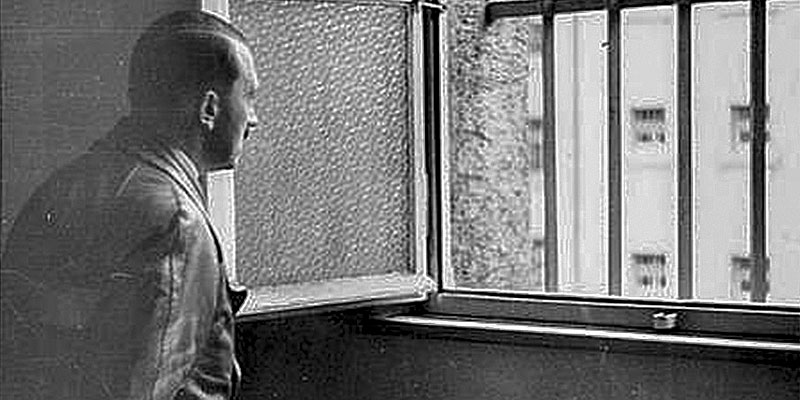
Hitler was imprisoned at Landsberg Prison, where conditions were remarkably lenient. He occupied a comfortable cell overlooking the surrounding countryside, received numerous visitors and was allowed to correspond extensively with supporters.
During his imprisonment, Hitler dictated much of the first volume of Mein Kampf to Rudolf Hess. The book combined autobiography with Hitler's racial ideology, antisemitism and political programme. Although initial sales were modest, it later became one of the central ideological works of the Nazi movement.
Despite receiving a five-year sentence, Hitler served only a little more than eight months. He was granted early release on 20 December 1924 for good behaviour. Shortly afterwards, he began rebuilding the Nazi Party, which had been temporarily banned following the failed coup.
Historical Significance
The failure of the Beer Hall Putsch fundamentally changed the future of both Adolf Hitler and the Nazi Party (NSDAP). Before November 1923, Hitler believed that Germany's democratic government could be overthrown through a swift armed revolution similar to Benito Mussolini's March on Rome. The collapse of the coup demonstrated that the German Army, police and civil authorities would not support such an uprising.
During his imprisonment at Landsberg Prison, Hitler concluded that the Weimar Republic could be destroyed more effectively from within than by force. Rather than attempting another violent revolution, he adopted the policy of Legalitätstaktik, or the "strategy of legality". The Nazi Party would contest elections, build a nationwide political organisation, exploit democratic institutions and use propaganda to win public support while gradually undermining the democratic system itself.
This strategic transformation proved decisive. After the Nazi Party was re-established in February 1925, Hitler reorganised it into a highly disciplined national movement with regional branches, specialised organisations and increasingly sophisticated propaganda. The lessons learned from the Beer Hall Putsch ultimately contributed to his appointment as Chancellor of Germany on 30 January 1933, leading to the establishment of the Third Reich, the persecution of political opponents, the Holocaust and the outbreak of the Second World War.
Legacy
Although the Beer Hall Putsch ended in failure, the Nazi Party carefully transformed it into one of its founding myths. The sixteen Nazi supporters killed during the march were portrayed as heroic martyrs who had sacrificed their lives for Germany's future. Their deaths became central to Nazi propaganda throughout the 1930s.
Every year on 9 November, senior Nazi leaders gathered in Munich to commemorate the failed coup. Elaborate ceremonies were held at the Feldherrnhalle, where the names of the fallen were read aloud and new members pledged their loyalty to Hitler. These annual commemorations reinforced the idea that the Nazi Party had been forged through sacrifice and struggle.
The anniversary acquired even greater significance on 9 November 1938. During the annual Beer Hall Putsch commemoration, Joseph Goebbels informed senior Nazi officials of the death of German diplomat Ernst vom Rath. Encouraged by Hitler, Goebbels used the gathering to unleash coordinated anti-Jewish violence across Germany and Austria. The attacks became known as Kristallnacht, forever linking the Beer Hall Putsch to one of the most notorious anti-Jewish pogroms in history.
Today, historians regard the Beer Hall Putsch as one of the defining turning points of the twentieth century. Although the coup itself failed, the political lessons Hitler learned during those two days ultimately proved far more dangerous than a short-lived armed rebellion.
Frequently Asked Questions
What was the Beer Hall Putsch?
The Beer Hall Putsch was a failed attempt by Adolf Hitler and the Nazi Party to overthrow the Bavarian Government on 8–9 November 1923 and begin a national revolution against the Weimar Republic.
Why did the Beer Hall Putsch fail?
The coup failed because Hitler was unable to secure the lasting support of the Bavarian authorities, while the army and police remained loyal to the government. Once Kahr, Lossow and Seisser escaped, they organised the suppression of the uprising.
Who took part in the Beer Hall Putsch?
Leading participants included Adolf Hitler, Erich Ludendorff, Ernst Röhm, Hermann Göring, Rudolf Hess, Heinrich Himmler, Ulrich Graf, Alfred Rosenberg and numerous members of the SA and other nationalist organisations.
How many people died during the Beer Hall Putsch?
The confrontation at the Feldherrnhalle resulted in the deaths of 16 Nazi supporters, 4 Bavarian police officers and 1 civilian bystander.
Why was Hitler given such a light sentence?
The Bavarian judiciary was generally sympathetic towards conservative nationalist defendants. Hitler received the minimum sentence for high treason and benefited from the relatively lenient conditions of fortress confinement.
What was the Blutfahne?
The Blutfahne, or Blood Flag, was a Nazi swastika flag reportedly stained with the blood of fallen putschists. It later became one of the most important ceremonial symbols of the Nazi Party.
Did the Beer Hall Putsch help Hitler?
Although the coup failed, the trial transformed Hitler into a nationally recognised political figure. His imprisonment also allowed him to dictate Mein Kampf and develop the political strategy that eventually brought the Nazi Party to power.
Why is the Beer Hall Putsch historically important?
The failed coup changed Hitler's strategy from armed revolution to gaining power through legal political means. That decision ultimately led to the Nazi seizure of power in 1933 and profoundly influenced the course of European history.
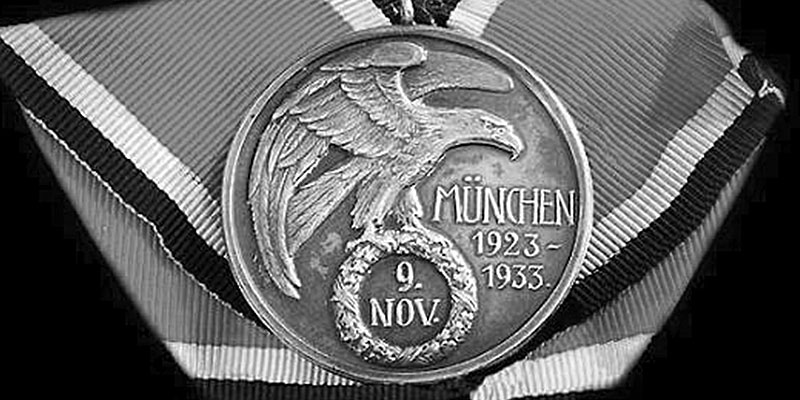
What was the Blood Order?
The Blood Order (Blutorden) was one of the highest decorations awarded by the Nazi Party. Introduced in 1934, it was initially presented to participants of the Beer Hall Putsch who had remained loyal to Hitler. In later years, it was also awarded to selected Nazis who had made exceptional contributions to the Party.
Principal Figure

in-depth information.