The Invasion of Poland marked the beginning of the Second World War in Europe. At dawn on 1 September 1939, Nazi Germany launched Operation Fall Weiss, a carefully planned assault designed to destroy the Polish state before Britain and France could intervene effectively. Just over two weeks later, on 17 September, the Soviet Union invaded Poland from the east under the secret terms of the Molotov–Ribbentrop Pact, sealing Poland's fate.
The campaign lasted just over five weeks, ending with the surrender of the last organised Polish field force on 6 October 1939. Although Poland was militarily defeated and divided between two occupying powers, it never formally surrendered. Its government continued the struggle from exile while Polish soldiers escaped to fight alongside the Allies throughout the remainder of the war.
The invasion demonstrated the effectiveness of Germany's highly coordinated use of armour, artillery and air power, but it also exposed the failure of Allied diplomacy to deter aggression. For millions of Polish civilians, the campaign marked the beginning of nearly six years of occupation, terror, persecution and mass murder that would become one of the darkest chapters of the Second World War.
Quick Facts
Date: 1 September – 6 October 1939
Location: Poland
German codename: Fall Weiss (Case White)
Main combatants: Poland, Nazi Germany, Soviet Union (from 17 September)
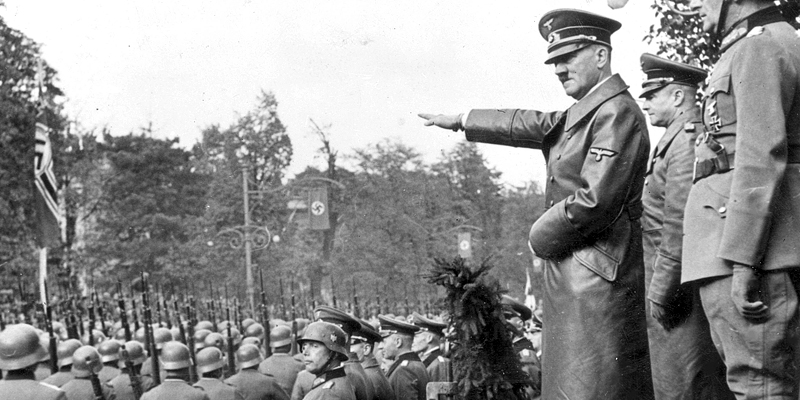
German commanders: Adolf Hitler, Walther von Brauchitsch, Fedor von Bock, Gerd von Rundstedt
Polish commander: Marshal Edward Rydz-Śmigły
Soviet commanders: Semyon Timoshenko, Mikhail Kovalyov
Outcome: German and Soviet victory; Poland divided between both powers
German invasion: 1 September 1939
Soviet invasion: 17 September 1939
Polish military losses: Approximately 65,000 killed, 133,000 wounded and over 660,000 captured
German losses: Approximately 16,000 killed and 30,000 wounded
Civilian deaths: Estimated 150,000–200,000 during the campaign
The Story
The road to war
The invasion of Poland was not an isolated act of aggression but the culmination of years of expansionist policies pursued by Adolf Hitler. After coming to power in 1933, Hitler openly rejected the post-First World War settlement created by the Treaty of Versailles. His long-term ambitions included uniting all ethnic Germans under one Reich, overturning Germany's territorial losses and acquiring vast areas of Lebensraum (living space) in Eastern Europe.
Relations between Germany and Poland initially appeared surprisingly stable. In 1934, both countries signed the German–Polish Non-Aggression Pact, temporarily easing tensions. For Hitler, however, the agreement was little more than a tactical pause. He hoped Poland would eventually become an ally against the Soviet Union, but successive Polish governments consistently refused to subordinate their independence to German ambitions or participate in anti-Soviet alliances.
By 1938, German foreign policy had become increasingly aggressive. Following the annexation of Austria and the dismantling of Czechoslovakia after the Munich Agreement, Hitler turned his attention toward Poland. Germany demanded the return of the Free City of Danzig, whose population was predominantly German and sought permission to construct an extraterritorial motorway and railway across the Polish Corridor to connect mainland Germany with East Prussia. Accepting these demands would have seriously undermined Polish sovereignty and Warsaw firmly rejected them.
The occupation of the remainder of Czechoslovakia in March 1939 convinced Britain and France that Hitler's ambitions extended far beyond revising the Treaty of Versailles. Both nations therefore guaranteed Poland's independence, promising military support should Germany attack. Rather than deterring Hitler, these guarantees accelerated German military planning. Hitler cancelled the non-aggression pact with Poland and ordered the Wehrmacht to prepare Fall Weiss, the invasion of Poland.
The Molotov–Ribbentrop Pact
One major obstacle remained. Germany wished to avoid fighting another two-front war similar to the disaster of the First World War. This problem was solved through a dramatic diplomatic breakthrough with the Soviet Union.
On 23 August 1939, German Foreign Minister Joachim von Ribbentrop travelled to Moscow, where he signed the Molotov–Ribbentrop Pact with Soviet Foreign Minister Vyacheslav Molotov in the presence of Joseph Stalin. Publicly, the agreement appeared to be nothing more than a non-aggression treaty. Secretly, however, it contained protocols dividing Eastern Europe into German and Soviet spheres of influence, including the partition of Poland.
The agreement fundamentally changed the strategic situation. Hitler no longer feared immediate Soviet intervention, while Stalin gained time to rebuild the Red Army after the devastating purges of the late 1930s. The pact effectively isolated Poland diplomatically and made a German invasion almost inevitable.
Hitler initially intended to invade on 26 August 1939, but postponed the operation when Britain formally concluded its military alliance with Poland the previous day. The delay lasted only a few days. During the final week of August, Germany intensified diplomatic pressure while simultaneously preparing military forces along the border.
To provide a propaganda justification for war, German security services organised several fabricated border incidents. The best known was the Gleiwitz Incident on the evening of 31 August 1939, when SS personnel disguised as Polish soldiers staged an attack on a German radio station. German media immediately portrayed the incident as evidence of Polish aggression, providing Hitler with the pretext he needed to launch the invasion the following morning.
Preparing for war
Although Germany possessed overwhelming military superiority, victory was far from guaranteed. The Wehrmacht deployed more than 1.5 million soldiers, supported by over 2,000 tanks, thousands of artillery pieces and one of the world's most experienced air forces. German commanders intended to destroy the Polish Army through rapid breakthroughs, deep encirclements and close cooperation between armoured formations, infantry and the Luftwaffe.
Poland faced enormous disadvantages. The country had regained independence only in 1918 after more than a century of foreign partition and was still developing its military industries. While Polish soldiers were well-trained and highly motivated, economic limitations prevented large-scale mechanisation. Many formations still relied heavily on horses for transport and only around 900,000 of the planned 1.35 million troops had reached their assigned positions before fighting began due to delayed mobilisation.
Polish military planners also faced a difficult strategic dilemma. Defending every kilometre of the frontier risked stretching their forces dangerously thin, yet abandoning important industrial regions without resistance could weaken Allied commitment to Poland's defence. As a result, many Polish armies were deployed close to the western border, leaving limited reserves available once the German offensive gathered momentum.
Geography further favoured the attackers. Germany could strike from the west, north and south, while the secret agreement with the Soviet Union threatened Poland from the east should Moscow decide to intervene. Once the invasion began, Polish commanders would have little opportunity to regroup before being confronted by overwhelming German firepower and mobility.
The invasion begins
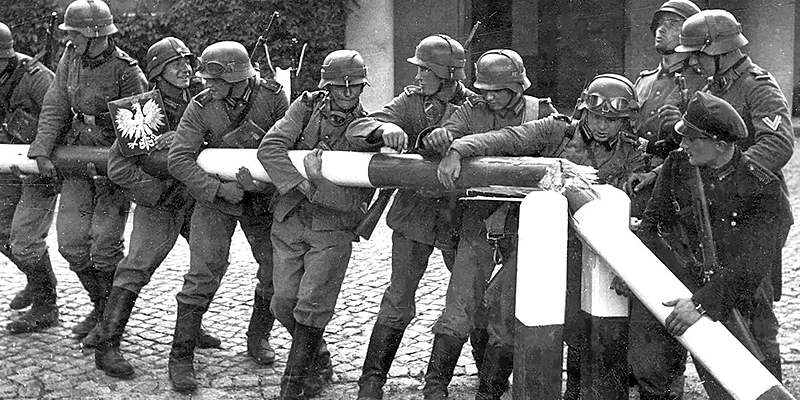
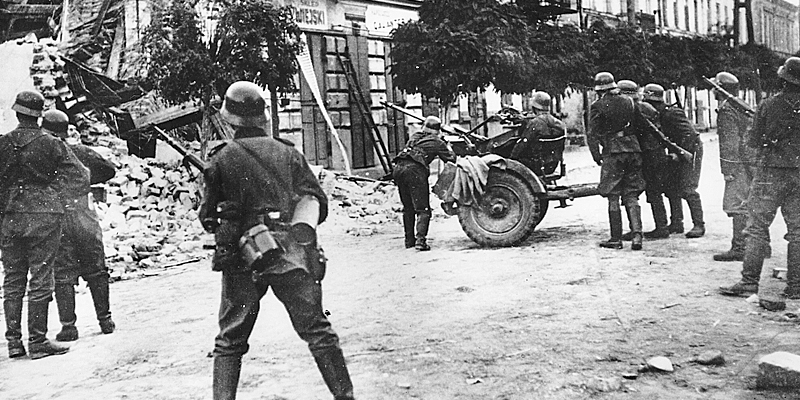
At 04:45 on the morning of 1 September 1939, the German battleship Schleswig-Holstein, anchored under the guise of a ceremonial visit in the Free City of Danzig, opened fire on the Polish Military Transit Depot at Westerplatte. The bombardment became one of the most recognisable opening moments of the war, although German air attacks against targets such as Wieluń occurred almost simultaneously. Without a formal declaration of war, Nazi Germany launched Fall Weiss, beginning the European phase of the Second World War.
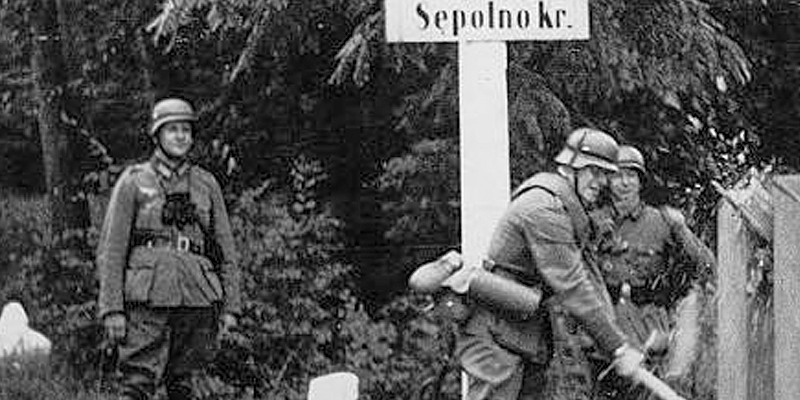
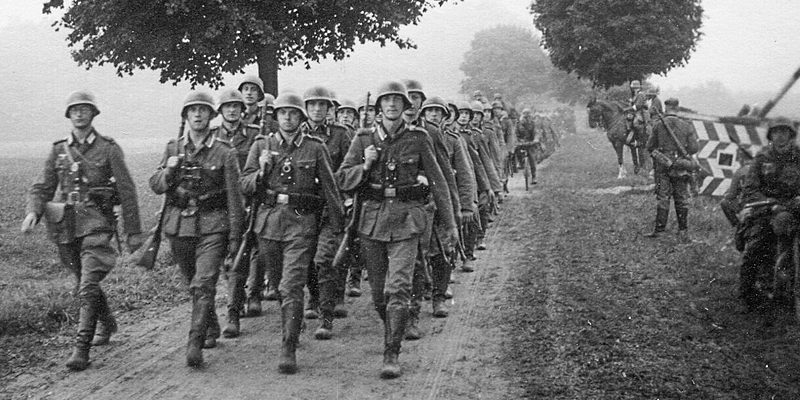
Across the frontier, German forces crossed into Poland along three principal axes. In the north, Army Group North, commanded by Colonel General Fedor von Bock, advanced south from East Prussia while simultaneously attacking eastward across the base of the Polish Corridor. In the south, Army Group South, under Colonel General Gerd von Rundstedt, attacked from Silesia and newly occupied Slovakia, aiming to envelop the main Polish armies and drive rapidly towards Warsaw.
Supporting the ground offensive was the Luftwaffe, whose aircraft struck Polish airfields, railway junctions, bridges, communication centres and troop concentrations. One of the earliest and most controversial attacks occurred against the undefended town of Wieluń, where hundreds of civilians were killed. The destruction of Wieluń has become widely recognised as one of the first terror bombings of the Second World War.
The Battle of the Border
The first phase of the campaign became known as the Battle of the Border. Polish forces resisted fiercely along much of the frontier despite being heavily outnumbered. German commanders expected rapid victories, but numerous local engagements demonstrated the determination and professionalism of the Polish Army.
One of the best-known actions took place during the Battle of Mokra on 1 September. The Wołyńska Cavalry Brigade, supported by anti-tank guns, artillery and an armoured train, successfully repelled repeated attacks by the 4th Panzer Division. The battle inflicted significant German losses and demonstrated that Polish cavalry formations were modern mobile infantry rather than medieval horsemen armed only with sabres.
Elsewhere, Polish troops fought determined delaying actions around Mława, Jordanów and numerous fortified positions along the frontier. Although individual units often performed exceptionally well, Germany's overwhelming superiority in armour, artillery, motorisation and air power gradually forced Polish formations to withdraw.
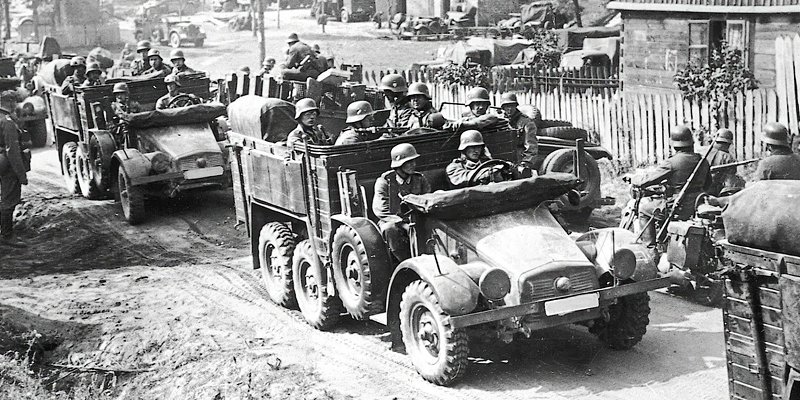
German armoured divisions avoided lengthy assaults on strongpoints whenever possible. Instead, they bypassed isolated defenders, penetrated deep into the Polish rear and severed vital communications and supply routes. Supported by constant Luftwaffe reconnaissance and bombing attacks, the Wehrmacht steadily disrupted the Polish command structure, making coordinated counterattacks increasingly difficult.
The myth of Blitzkrieg
The invasion of Poland is often described as the first example of Blitzkrieg, or "lightning war." While the campaign certainly showcased Germany's ability to combine tanks, infantry, artillery and aircraft into highly mobile operations, modern historians caution against viewing Blitzkrieg as a formally codified doctrine.
German operational planning still relied heavily on traditional concepts of encirclement and destruction (Vernichtungsgedanke). Armoured formations were generally expected to support the advance of the infantry rather than conduct completely independent deep penetrations. Nevertheless, the speed and coordination achieved during the campaign astonished military observers around the world and fundamentally altered perceptions of modern warfare.
Britain and France declare war
As German forces advanced across Poland, diplomatic efforts finally collapsed. On 3 September 1939, Great Britain and France honoured their guarantees to Poland by declaring war on Nazi Germany. Across Poland, the announcement was greeted with relief. Many Polish political and military leaders believed that a major Allied offensive against Germany's western frontier would soon force Hitler to divert large numbers of troops away from Poland.
That expectation was never fulfilled. Although France launched the limited Saar Offensive, French forces advanced only a short distance into lightly defended German territory before halting. No large-scale offensive developed and British forces were still in the early stages of mobilisation. Poland was therefore left to confront Germany largely alone.
The lack of immediate Allied military action later became known as part of the so-called Phoney War, a period during which Britain and France were officially at war with Germany but undertook few major offensive operations on the Western Front.
The drive towards Warsaw
By the first week of September, German advances had broken through much of the Polish frontier defence system. On 6 September, Marshal Edward Rydz-Śmigły ordered a general withdrawal towards central and southeastern Poland in an attempt to preserve the remaining field armies.
German motorised formations advanced with remarkable speed. General Walter von Reichenau's 10th Army pushed through central Poland, exploiting gaps created by earlier breakthroughs and threatening to encircle large Polish formations. Covering more than 220 kilometres in just eight days, forward German armoured units reached the outskirts of Warsaw on 8 September 1939.
Despite the rapid German advance, Warsaw did not collapse. The city's defenders, commanded by General Walerian Czuma, together with civilian authorities led by the energetic mayor Stefan Starzyński, organised determined resistance. Improvised barricades, hastily assembled defensive positions and determined counterattacks forced German armoured units to withdraw from the city centre and prepare for a prolonged siege instead of the quick victory they had anticipated.
The Battle of the Bzura
While German forces concentrated on Warsaw, the Polish high command recognised an opportunity to strike back. The Poznań Army and Pomorze Army, commanded by General Tadeusz Kutrzeba, had avoided complete encirclement during the opening stages of the invasion. Observing that the flank of the advancing German 8th Army had become exposed, Kutrzeba planned a large-scale counteroffensive west of Warsaw.
Beginning on 9 September 1939, the Battle of the Bzura became the largest engagement of the September Campaign. Polish infantry and cavalry launched powerful attacks that initially surprised the Germans, recapturing several towns and forcing the Wehrmacht to halt parts of its advance towards Warsaw. For several days, Polish troops demonstrated that, under favourable circumstances, they could successfully challenge German infantry formations.
The German response, however, revealed the decisive importance of air superiority and operational mobility. Large numbers of Luftwaffe aircraft were redirected to the battlefield, carrying out relentless bombing attacks against Polish troop concentrations, bridges and supply routes. German armoured formations gradually surrounded the attacking Polish armies, while artillery and dive-bombers shattered attempts to break out.
By the middle of September, the counteroffensive had failed. Although thousands of Polish soldiers succeeded in escaping towards Warsaw and reinforced the capital's defenders, most participating formations were destroyed or forced to surrender. The defeat removed Poland's last realistic opportunity to regain the strategic initiative and allowed German forces to concentrate their full strength on completing the conquest of the country.
The Romanian Bridgehead
Following the collapse of the frontier defences and the failure to halt the German advance towards Warsaw, Marshal Edward Rydz-Śmigły ordered the remaining Polish armies to withdraw towards southeastern Poland. This strategy, known as the Romanian Bridgehead, aimed to establish a final defensive stronghold near the borders of Romania and Hungary.
The plan relied upon the rugged terrain of the Carpathian Mountains and the region's major rivers to slow any German advance. More importantly, Polish leaders hoped that supplies, ammunition and reinforcements could continue to reach them through neutral Romanian ports on the Black Sea. If the Polish Army could hold out until the spring of 1940, many believed that Britain and France would eventually launch a major offensive against Germany in the west.
Although strategically sound under the circumstances, the Romanian Bridgehead depended entirely upon Poland continuing to face only one enemy. That assumption would prove fatally optimistic.
The Soviet invasion
In the early hours of 17 September 1939, the strategic situation changed dramatically. Acting under the secret provisions of the Molotov–Ribbentrop Pact, the Soviet Union invaded Poland from the east. More than 800,000 Red Army soldiers crossed the frontier, advancing on a broad front from the Baltic region to the Carpathian Mountains.
The Soviet government justified its invasion by claiming that the Polish state had ceased to exist and that it was intervening to protect Ukrainian and Belarusian minorities living in eastern Poland. In reality, the invasion fulfilled the secret agreement reached with Nazi Germany only weeks earlier, dividing Poland between two totalitarian powers.
The eastern frontier was defended primarily by lightly equipped units of the Border Protection Corps (Korpus Ochrony Pogranicza). Faced with overwhelming Soviet numerical superiority and already engaged in desperate fighting against Germany, Marshal Edward Rydz-Śmigły instructed his forces to avoid large-scale combat with Soviet troops wherever possible and instead attempt to withdraw towards Romania and Hungary.
Not all Polish units obeyed or were able to follow these instructions. Fierce engagements erupted at places such as Grodno and Szack, where Polish soldiers and civilian volunteers resisted stubbornly before eventually being overwhelmed by superior Soviet numbers.
Poland trapped between two invaders
The Soviet invasion completely destroyed the Romanian Bridgehead strategy. Instead of retreating into a defensible enclave, Polish formations now found themselves surrounded from every direction. Their lines of communication collapsed, organised coordination became increasingly difficult and hopes of maintaining a continuous front disappeared.
During the night of 17–18 September 1939, President Ignacy Mościcki, members of the Polish government and the military high command crossed into neutral Romania. Under heavy diplomatic pressure from both Berlin and Moscow, Romanian authorities interned the Polish leadership, preventing them from continuing the war directly from Romanian territory.
Although the government had left the country, Poland did not surrender. Within weeks, a new Polish Government-in-Exile was established in France, later relocating to London after the fall of France in 1940. It continued to represent Poland internationally for the remainder of the war.
The meeting at Brest-Litovsk
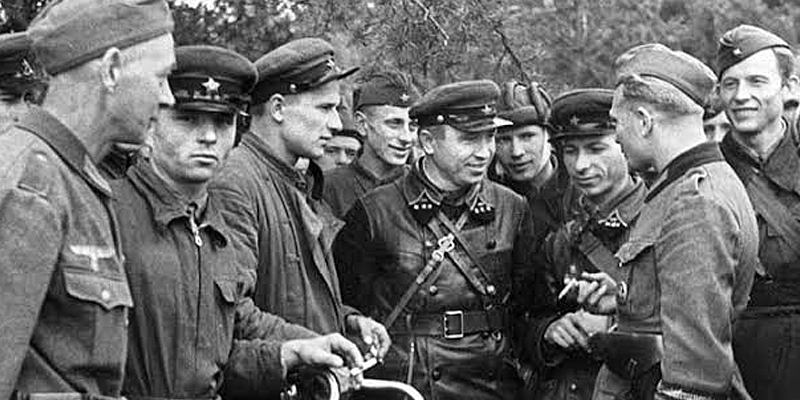
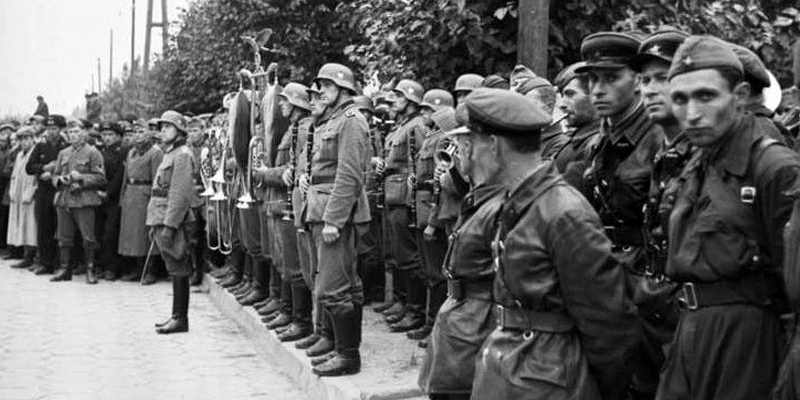
As German and Soviet forces completed the partition of Poland, both armies met at numerous locations along the newly agreed demarcation line. One of the best-known encounters occurred at Brest-Litovsk on 22 September 1939, where German forces handed the city over to the advancing Red Army.
A formal military ceremony accompanied the transfer. German commander General Heinz Guderian and Soviet brigade commander Semyon Krivoshein reviewed their troops before German forces withdrew and Soviet units occupied the city. Although often described as a "joint victory parade," modern historians generally regard the event as a ceremonial transfer of authority rather than a full combined military parade.
The images recorded at Brest-Litovsk remain among the most striking visual reminders that, during the opening weeks of the war, Nazi Germany and the Soviet Union cooperated closely in dismantling the Polish state.
The siege of Warsaw
While political events unfolded elsewhere, Warsaw continued its determined resistance. German commanders expected the Polish capital to surrender quickly, but the defenders, supported by thousands of civilians, transformed the city into a formidable defensive position.
Throughout September, the Luftwaffe and German artillery subjected Warsaw to continuous bombardment. Residential districts, hospitals, public buildings, power stations and water supplies suffered extensive damage. The civilian population endured constant shelling, fires and severe shortages of food and medical supplies.
The most devastating aerial assault occurred on 25 September 1939, often referred to as "Black Monday." During the attack, the Luftwaffe flew more than 1,100 bombing sorties against the city while heavy artillery simultaneously shelled defensive positions. Much of Warsaw's infrastructure was destroyed, leaving large areas of the capital in ruins.
Recognising that continued resistance would result only in further civilian casualties and destruction, General Juliusz Rómmel negotiated the city's surrender. Warsaw officially capitulated on 28 September 1939 after nearly four weeks of determined resistance.
The final battles
Although Warsaw had fallen, fighting continued elsewhere. The fortress of Modlin, located north of the capital, resisted until 29 September, while isolated Polish units continued to defend positions across the country.
On the Baltic coast, the garrison of the Hel Peninsula, commanded by Rear Admiral Józef Unrug, successfully resisted repeated German naval, air and artillery attacks. Protected by coastal fortifications and the narrow geography of the peninsula, the defenders held out until 2 October 1939, becoming one of the last organised centres of Polish resistance.
The final major engagement of the campaign took place during the Battle of Kock. The Independent Operational Group Polesie, commanded by General Franciszek Kleeberg, fought a series of determined actions against superior German forces between 2 and 5 October. Despite tactical successes, the Polish troops eventually exhausted their ammunition, food and medical supplies.
On 6 October 1939, General Kleeberg formally surrendered his command. His capitulation marked the end of organised military resistance during the September Campaign, although the Polish struggle against both occupiers had only just begun.
The occupation begins
Following the campaign, Germany and the Soviet Union formally divided Poland under the German–Soviet Boundary and Friendship Treaty of 28 September 1939. Germany annexed western Polish territories directly into the Reich, while the country's central region became the General Government, administered by Hans Frank from Kraków.
Eastern Poland was incorporated into the Belorussian and Ukrainian Soviet Socialist Republics. Soviet authorities immediately introduced widespread arrests, deportations and forced collectivisation. Hundreds of thousands of Polish citizens were transported to remote regions of the Soviet Union, while thousands of Polish military officers would later be murdered during the Katyn Massacre in 1940.
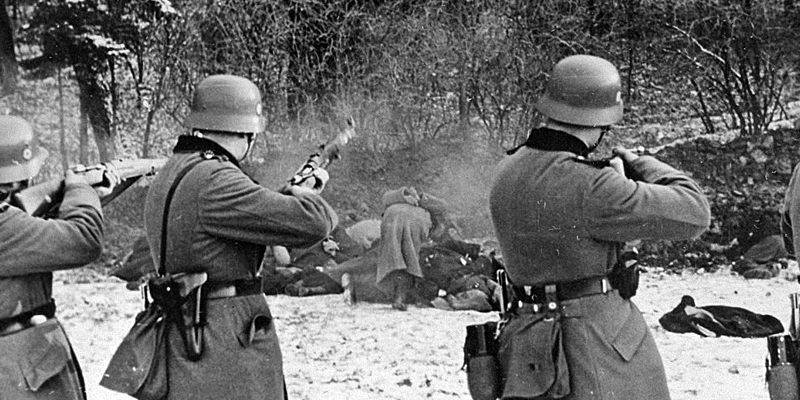
German occupation policies proved equally brutal. Special SS Einsatzgruppen, assisted by the Volksdeutscher Selbstschutz, launched Operation Tannenberg, systematically targeting Poland's political, religious, military and intellectual elite. Tens of thousands of teachers, priests, officers, judges and community leaders were murdered during the opening months of the occupation as part of Germany's plan to destroy the foundations of the Polish nation.
Although Poland had been conquered and partitioned, it had not ceased to exist. The Polish state continued the war through its government-in-exile, while an extensive underground resistance movement gradually developed inside occupied Poland. Over the following six years, Polish soldiers, sailors and airmen would fight alongside the Allies on battlefields stretching from the Battle of Britain to the beaches of Normandy, ensuring that Poland remained an active participant in the Allied victory despite the loss of its homeland.
Persistent myths of the September Campaign
The invasion of Poland gave rise to several enduring myths that continued to circulate for decades after the war. Many originated from wartime propaganda, while others resulted from oversimplified interpretations of Germany's rapid victory. Modern historical research has corrected many of these misconceptions, providing a far more accurate understanding of the campaign.
Did Polish cavalry charge German tanks?
Perhaps the best-known myth is that Polish cavalry repeatedly charged German tanks with sabres and lances. This story became one of the most enduring pieces of wartime propaganda and continues to appear in popular culture today. The misconception originated after the Battle of Krojanty on 1 September 1939. During the engagement, elements of the 18th Pomeranian Uhlan Regiment successfully charged exposed German infantry, forcing them to retreat. Shortly afterwards, German armoured reconnaissance vehicles unexpectedly appeared and opened fire on the cavalrymen, causing heavy casualties.
Foreign journalists visiting the battlefield the following day misunderstood, or repeated German propaganda about, the events they observed. Reports soon claimed that Polish horsemen had recklessly attacked German tanks with sabres. In reality, Polish cavalry functioned as highly mobile infantry. Horses provided rapid movement across difficult terrain, but cavalrymen normally dismounted before combat and fought using rifles, machine guns, anti-tank weapons and artillery.
Was the Polish Air Force destroyed on the ground?
Another widespread misconception claims that the Polish Air Force was eliminated during the opening hours of the invasion. German propaganda proudly announced that Polish aviation had been destroyed almost immediately. In reality, Polish commanders had anticipated attacks against their principal airfields and dispersed most operational aircraft to concealed auxiliary landing grounds before the invasion began. The Luftwaffe's first bombing raids therefore destroyed mainly training aircraft, obsolete reserve machines and empty hangars rather than the bulk of Poland's frontline air force.
Although heavily outnumbered and flying largely obsolete fighters such as the PZL P.11, Polish pilots continued fighting for more than two weeks. They inflicted significant losses on the Luftwaffe before shortages of fuel, spare parts and serviceable airfields eventually forced surviving aircraft to withdraw to Romania.
Was Blitzkrieg already a perfected doctrine?
The invasion of Poland is frequently presented as the first perfect example of Blitzkrieg. While Germany undeniably demonstrated an impressive ability to coordinate tanks, infantry, artillery and aircraft, historians now generally agree that Blitzkrieg was not a formally codified military doctrine in 1939.
German commanders still relied heavily upon traditional operational concepts centred on rapid encirclement and the destruction of enemy armies. Armoured divisions usually remained closely integrated with infantry formations rather than operating independently over great distances. Nevertheless, the extraordinary speed of the campaign profoundly influenced military thinking worldwide and foreshadowed Germany's even more spectacular victories in Western Europe the following year.
Principal Figure

in-depth information.