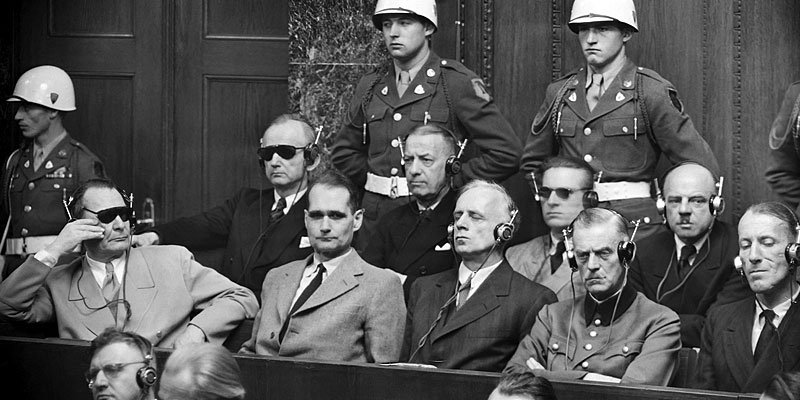
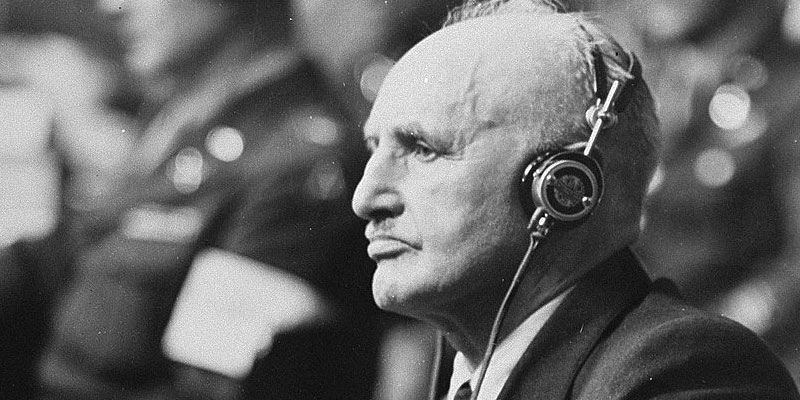
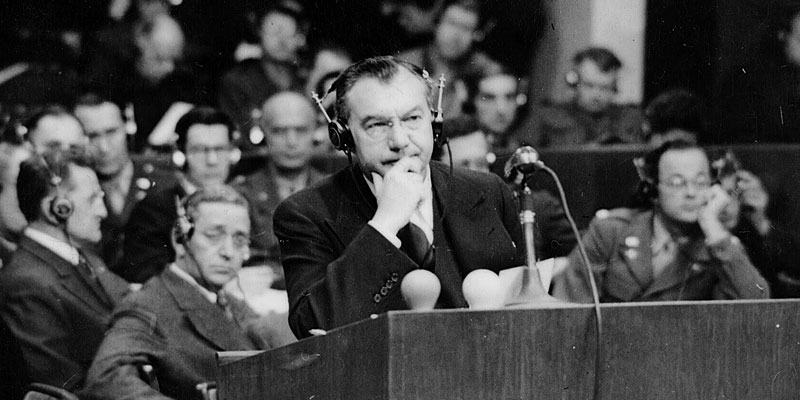
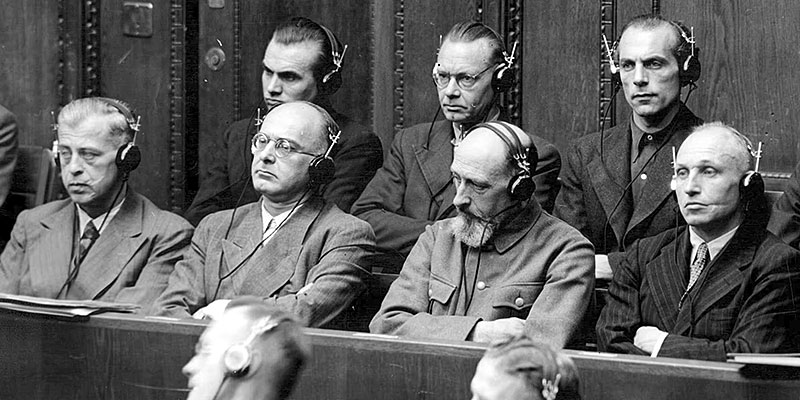
Following the defeat of Nazi Germany in May 1945, the victorious Allied powers faced an unprecedented challenge: how should those responsible for planning aggressive war, genocide, war crimes and crimes against humanity be brought to justice? Rather than carrying out summary executions, the United States, the United Kingdom, France and the Soviet Union established the International Military Tribunal (IMT) in Nuremberg. Between 20 November 1945 and 1 October 1946, leading political, military and economic figures of the Third Reich stood trial in the first international tribunal created to hold individuals personally accountable for major crimes under international law.
The Nuremberg Trials did more than determine the fate of the surviving leaders of Nazi Germany. They publicly documented the regime’s machinery of aggression, occupation, persecution, forced labour and mass murder. The proceedings established that government officials, military commanders and political leaders could not hide behind the authority of the state, their official positions or orders from their superiors. The legal principles developed at Nuremberg continue to influence international criminal law today.
Quick Facts
Date: 20 November 1945 – 1 October 1946
Location: Palace of Justice, Nuremberg, Germany
Tribunal: International Military Tribunal
Allied powers: United States, United Kingdom, France and Soviet Union
Defendants: 24 indicted; 21 physically present in the courtroom; Martin Bormann tried in absentia
Charges: Conspiracy, crimes against peace, war crimes and crimes against humanity
Death sentences: 12
Prison sentences: 7
Acquittals: 3
Significance: The first international tribunal to prosecute senior leaders for crimes against peace, war crimes and crimes against humanity
Why Were the Nuremberg Trials Held?
While the Allied landings in Normandy in June 1944 marked the beginning of the liberation of Western Europe, the end of the Second World War raised an entirely new challenge. The Allies had defeated Nazi Germany militarily, but they still had to decide what should happen to the surviving leaders responsible for starting the war and directing the regime’s crimes. Between 1939 and 1945, Nazi Germany invaded and occupied numerous sovereign countries, including Poland, Denmark, Norway, the Netherlands, Belgium, Luxembourg, France, Yugoslavia, Greece and the Soviet Union. German occupation brought economic exploitation, mass executions, the destruction of communities, forced labour, the deliberate starvation of prisoners and civilians, and widespread reprisals against resistance movements.
At the centre of Nazi criminal policy was the systematic persecution and murder of Europe’s Jews. Approximately six million Jewish men, women and children were murdered during the Holocaust. Millions of other people were also persecuted, imprisoned, deported or killed, including Soviet prisoners of war, Roma and Sinti, disabled people, Polish civilians, political opponents, resistance members, homosexual men, Jehovah’s Witnesses and others whom the Nazi regime considered undesirable or dangerous.
The war caused destruction on a scale Europe had never previously experienced. The Soviet Union suffered approximately 27 million military and civilian deaths. Across the continent, entire cities, villages and communities had been destroyed, while millions of displaced people struggled to return home or discover what had happened to their families.
Early Demands for Justice
The demand for an international reckoning began before the war had ended. On 13 January 1942, representatives of nine governments from occupied Europe met at St James’s Palace in London. They issued a declaration calling for the punishment of those responsible for crimes committed against civilian populations. The governments represented Belgium, Czechoslovakia, France, Greece, Luxembourg, the Netherlands, Norway, Poland and Yugoslavia. Their declaration expressed the determination to ensure that those responsible for organised violence against civilians would be identified, prosecuted and punished through organised justice.
Initially, the United States and the United Kingdom remained cautious. Their governments remembered the limited and largely unsuccessful attempts to prosecute German war criminals after the First World War. Many suspected perpetrators had escaped justice, while trials conducted in Germany had resulted in only a small number of convictions and relatively light sentences. As the Second World War continued, however, evidence of Nazi criminality became impossible to ignore. Reports reached the Allied governments describing mass shootings in occupied Eastern Europe, the deportation of Jewish communities, the operation of killing centres and the systematic murder of millions of civilians.
The demand for justice emerged while the war was still being fought, as occupied nations insisted that liberation must be followed by accountability.
The Moscow Declaration
On 1 November 1943, the United States, the United Kingdom and the Soviet Union issued the Moscow Declaration on German Atrocities. The declaration warned Nazi officials and collaborators that they would be pursued and brought to justice after the war. Perpetrators whose crimes had been committed in a particular country would be returned to that country for prosecution under its national laws. High-ranking officials whose crimes extended across several countries and could not be assigned to one geographical location would be punished through a joint decision by the Allied governments.
The declaration made clear that military defeat would not allow Nazi leaders to escape responsibility. However, it did not yet determine whether the principal defendants would be executed, tried by national courts or prosecuted before a new international tribunal.
The declaration established that Nazi perpetrators would be pursued across borders and that senior leaders would face a joint Allied decision.
Disagreement Among the Allies
Although the Allies agreed that leading Nazi officials had to be punished, they initially disagreed about how justice should be administered. The British government favoured the summary execution of a limited group of senior Nazi leaders. British officials feared that a lengthy trial would give the defendants a public platform and might become trapped in complicated legal arguments about whether aggressive war had already been clearly defined as an international crime.
The Soviet Union supported public trials and strongly promoted the concept of criminal responsibility for aggressive war. Soviet jurist Aron Trainin had developed influential arguments concerning what became known as crimes against peace. However, Soviet leaders tended to view the trial as a political proceeding in which the guilt of the defendants had already been established. The United States increasingly supported a formal judicial process based on documentary evidence, defence counsel and publicly presented legal arguments. American officials believed that a transparent trial would demonstrate the rule of law, establish an authoritative historical record and show the German population the criminal nature of the regime that had governed them.
The issue remained unresolved at the Yalta Conference in February 1945. Following Germany’s unconditional surrender on 8 May 1945, the Allied governments moved rapidly towards creating a joint international court.
The Allies eventually chose a public judicial process over summary punishment, accepting that justice had to be demonstrated through evidence and law.
The London Charter and the Legal Framework
Representatives of the United States, the United Kingdom, France and the Soviet Union met in London between 26 June and 8 August 1945. Their task was to determine the jurisdiction, procedures and legal authority of the proposed tribunal. The negotiations resulted in the London Agreement and the accompanying Charter of the International Military Tribunal, signed on 8 August 1945. The charter established the court, defined the crimes within its jurisdiction and set out the procedures under which the defendants would be prosecuted.
The Nuremberg Charter challenged traditional understandings of international law. International law had generally been concerned with the conduct of sovereign states. The charter declared that individuals could also be held criminally responsible for actions committed in the name of a government or state.
The Four Counts of the Indictment
The defendants were prosecuted under four counts:
Count One – Common plan or conspiracy:
Participation in a common plan or conspiracy to commit crimes against peace, war crimes and crimes against humanity.
To prove the charge of a common conspiracy, prosecutors at nuremberg meticulously documented the regime's early consolidation of power, tracing a direct line from the failed Beer Hall Putsch which took place on 8–9 November 1923, to the systematic radicalization of the state. the absolute authority wielded by the defendants in the nuremberg dock was forged years earlier through the violent elimination of internal political rivals, most notably during the Night of the Long Knives which took place between 30 June and 2 July 1934.
Count Two – Crimes against peace:
The planning, preparation, initiation or waging of wars of aggression, or participation in a common plan or conspiracy to wage aggressive war.
Count Three – War crimes:
Violations of the established laws and customs of war, including the murder or mistreatment of prisoners of war and civilians, deportation for forced labour, killing of hostages, plunder of property and unnecessary destruction.
Count Four – Crimes against humanity:
Murder, extermination, enslavement, deportation, persecution and other inhumane acts committed against civilian populations.
Together, the four counts allowed the tribunal to examine aggressive war, battlefield crimes and systematic atrocities against civilian populations.
Crimes Against Peace
The prosecution of aggressive war was one of the most important and controversial features of the tribunal. American chief prosecutor Robert H. Jackson insisted that the planning and waging of aggressive war had to form a central part of the case. Jackson argued that the invasion of other countries was not merely a political act. It was the fundamental crime that made the subsequent occupation, exploitation, deportation and killing possible. Without the wars of aggression, many of the other crimes presented before the tribunal could not have occurred on such an enormous scale.
At Nuremberg, aggressive war was treated as the act that opened the way to occupation, exploitation, deportation and mass killing.
War Crimes
War crimes were already recognised under existing laws and customs of war, including provisions associated with the Hague and Geneva conventions. The prosecution presented evidence concerning the execution and mistreatment of prisoners of war, the murder of hostages, the destruction of towns and villages, forced labour, deportation and the plundering of occupied territories.
The evidence showed that violations of the laws of war had often resulted from organised policies rather than isolated acts committed without authority.
Crimes Against Humanity
The category of crimes against humanity was developed to address systematic atrocities committed against civilian populations. It allowed prosecutors to present evidence of persecution, deportation and mass murder carried out as part of Nazi policy. The tribunal’s jurisdiction over crimes against humanity was limited by the requirement that the acts had to be connected to another crime within the tribunal’s jurisdiction, particularly aggressive war. This limitation reflected the reluctance of the Allied powers to create a court with unrestricted authority over a government’s treatment of its own citizens during peacetime.
The compromise also protected the participating powers from legal scrutiny of their own domestic policies. The United States continued to maintain institutionalised racial segregation, while the Soviet Union had carried out political purges, executions, mass deportations and forced population transfers.
Nuremberg gave international legal recognition to the systematic murder, deportation and persecution of civilian populations.
Official Position and Superior Orders
Article 7 of the charter established that the official position of a defendant, including service as a head of state or senior government official, did not remove personal responsibility or automatically reduce punishment. Article 8 stated that acting under the orders of a government or superior officer did not free a defendant from responsibility. Obedience to orders could be considered when determining punishment, but it was not a complete defence. These provisions established a central principle of the tribunal: individuals had a responsibility to refuse participation in criminal acts, even when those acts were ordered or authorised by the state.
The charter established that rank, public office and obedience to orders could not automatically remove personal criminal responsibility.
Why Was Nuremberg Chosen?
The International Military Tribunal was held in the American occupation zone at the Palace of Justice in Nuremberg. The building had survived the Allied bombing of the city in relatively good condition and contained enough space for the courtroom, offices, translators, journalists and prosecution teams. An attached prison allowed the defendants to be held securely beside the courthouse. This reduced the risks and logistical difficulties involved in transporting them through a heavily damaged city.
Nuremberg also held powerful symbolic significance. Before the war, the city had hosted the enormous annual rallies of the Nazi Party. It was closely associated with the public spectacle, propaganda and political mythology of the Third Reich. The antisemitic Nuremberg Laws had also been announced during the Nazi Party Rally of 1935. Holding the trial in the same city symbolised the complete reversal of Nazi power: a place once used to celebrate dictatorship and racial persecution became the location where the regime’s leaders were required to answer for their crimes.
A city once used to glorify Nazi power became the place where the surviving leadership of the regime was required to answer for its crimes.
The Tribunal and the Prosecution Teams
Each of the four Allied powers appointed a principal judge, an alternate judge and a chief prosecutor. The proceedings required extensive cooperation between legal teams with different languages, judicial traditions and political priorities. By early 1946, approximately one thousand people were working in connection with the tribunal. They included lawyers, researchers, archivists, translators, interpreters, psychologists, administrators, guards and technical personnel.
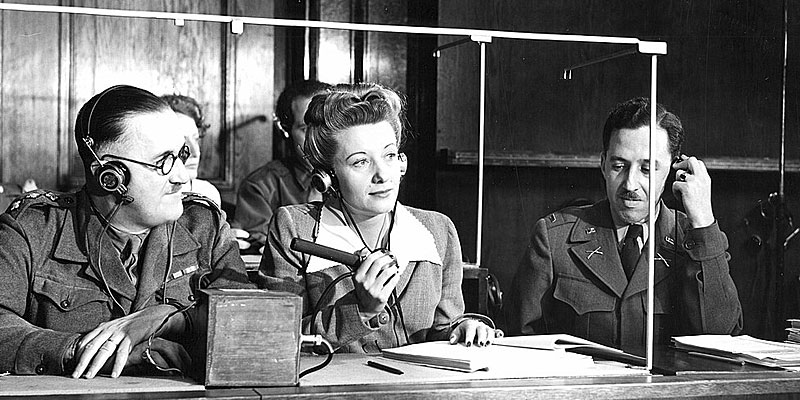
The trial was conducted in English, French, Russian and German. A pioneering system of simultaneous interpretation allowed the proceedings to continue without waiting for every statement to be translated separately into all four languages.
The United States
The American prosecution was led by Robert H. Jackson, an associate justice of the United States Supreme Court. Jackson played a central role in negotiating the charter and shaping the overall prosecution strategy. The American case focused heavily on the existence of a common plan or conspiracy through which Nazi leaders had seized power, destroyed political opposition, prepared Germany for war and launched a series of aggressive invasions. Francis Biddle served as the principal American judge, with John J. Parker as his alternate.
The American prosecution sought to prove the case primarily through records created and preserved by the Nazi state itself.
The United Kingdom
The British prosecution was led by Attorney General Hartley Shawcross, assisted by lawyers including David Maxwell Fyfe. The British team took primary responsibility for presenting the case concerning crimes against peace and the successive acts of aggression committed by Nazi Germany. British judge Sir Geoffrey Lawrence served as president of the International Military Tribunal. His alternate was Sir Norman Birkett.
The British case documented the sequence of treaties, threats and invasions through which Nazi Germany pursued aggressive expansion.
France
The French prosecution was initially led by François de Menthon and later by Auguste Champetier de Ribes. The French case concentrated on crimes committed in Western Europe, including executions, deportations, forced labour, economic plunder and the persecution of civilian populations. Henri Donnedieu de Vabres served as the principal French judge, with Robert Falco as his alternate.
The French prosecution ensured that occupation, forced labour, economic plunder and persecution in Western Europe formed part of the tribunal’s record.
The Soviet Union
The Soviet prosecution was led by General Roman Rudenko. The Soviet case documented the enormous destruction caused by the German invasion and occupation of the Soviet Union, including the murder of civilians, the destruction of villages and the deliberate starvation and mistreatment of Soviet prisoners of war. Major General Iona Nikitchenko served as the principal Soviet judge, with Lieutenant Colonel Alexander Volchkov as his alternate. The Soviet delegation operated under close political supervision from Moscow. This limited its ability to respond independently when unexpected evidence or legal challenges arose during the proceedings.
The Soviet case documented the immense destruction, starvation and mass killing caused by Germany’s war in the East.
The Defendants
The prosecution indicted 24 senior political, military and economic figures who represented important parts of the Nazi state. Six organisations were also indicted so that the tribunal could determine whether they should be declared criminal organisations. Several of the most important leaders of the Nazi regime could not be brought to trial. Adolf Hitler, Heinrich Himmler and Joseph Goebbels had committed suicide during the final collapse of Nazi Germany.
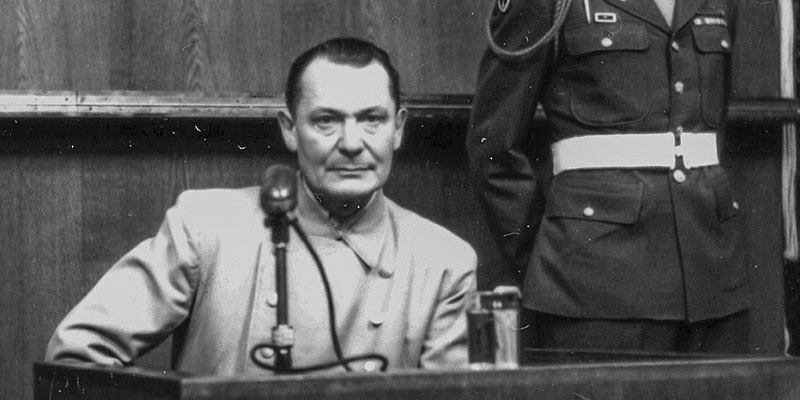
The most prominent surviving defendant was Hermann Göring, who had served as commander-in-chief of the Luftwaffe, president of the Reichstag and one of Hitler’s most powerful associates. Göring attempted to dominate the other defendants and frequently challenged the prosecution during his testimony.
Other major defendants included:
- Martin Bormann: Head of the Nazi Party Chancellery and Hitler’s powerful private secretary. He was tried in absentia because his fate was not yet known.
- Karl Dönitz: Commander-in-chief of the German Navy and Hitler’s designated successor as head of state.
- Hans Frank: Governor-General of occupied Poland.
- Wilhelm Frick: Minister of the Interior and one of the architects of Nazi racial legislation.
- Hans Fritzsche: Senior official in the Propaganda Ministry and radio broadcaster.
- Walther Funk: Minister of Economics and president of the Reichsbank.
- Rudolf Hess: Hitler’s former deputy, who had flown to Britain in 1941.
- Alfred Jodl: Chief of the Operations Staff of the Armed Forces High Command.
- Ernst Kaltenbrunner: Chief of the Reich Security Main Office following the death of Reinhard Heydrich.
- Wilhelm Keitel: Chief of the Armed Forces High Command.
- Gustav Krupp von Bohlen und Halbach: Industrialist and head of the Krupp armaments company.
- Robert Ley: Leader of the German Labour Front.
- Konstantin von Neurath: Former foreign minister and Reich Protector of Bohemia and Moravia.
- Franz von Papen: Former chancellor and vice-chancellor under Hitler.
- Erich Raeder: Former commander-in-chief of the German Navy.
- Joachim von Ribbentrop: Foreign minister of Nazi Germany.
- Alfred Rosenberg: Nazi Party ideologue and minister for the occupied eastern territories.
- Fritz Sauckel: Official responsible for the forced recruitment and deportation of foreign labourers.
- Hjalmar Schacht: Former minister of economics and president of the Reichsbank.
- Baldur von Schirach: Former leader of the Hitler Youth and Gauleiter of Vienna.
- Arthur Seyss-Inquart: Reich Commissioner for the occupied Netherlands.
- Albert Speer: Minister of Armaments and War Production.
- Julius Streicher: Publisher of the violently antisemitic newspaper Der Stürmer.
Not all 24 indicted men were present when the trial began. Robert Ley committed suicide in his cell on 25 October 1945. Gustav Krupp was ruled medically unfit to stand trial. Martin Bormann was tried and sentenced in absentia.
The men in the dock represented the political, military, economic and administrative structures through which Nazi policy had been put into practice.
The Organisations on Trial
The prosecution also indicted six organisational groupings associated with Nazi rule:
- The Leadership Corps of the Nazi Party
- The Reich Cabinet
- The Schutzstaffel (SS)
- The Sturmabteilung (SA)
- The Gestapo and Sicherheitsdienst (SD)
- The General Staff and High Command of the German Armed Forces
The purpose was not to declare every person who had ever belonged to these organisations automatically guilty. Instead, the prosecution sought to establish that certain organisations had been used systematically to commit criminal acts. A criminal declaration could then assist later national proceedings against individual members.
A unique aspect of the tribunal was the prosecution of entire institutions rather than just individuals. the trials effectively dismantled and legally condemned the Rise of the SS, officially declaring it a criminal organization due to its pervasive, state-sponsored involvement in war crimes and the holocaust.
The organisational case examined how institutions could become instruments through which criminal policies were planned and carried out.
The Presentation of Evidence
The prosecution relied heavily on documents created by the Nazi regime itself. Allied forces had captured enormous quantities of official correspondence, military directives, meeting records, transport documents, reports, diaries, speeches and administrative files during the final months of the war. American and British prosecutors believed that using the defendants’ own documents would make it difficult to dismiss the evidence as propaganda, hearsay or survivor exaggeration. The records demonstrated that many crimes had been planned, recorded and reported through ordinary government and military channels.
More than 100.000 captured German documents were examined during preparation for the case. Thousands of documents were formally submitted as evidence, accompanied by photographs, maps, films and witness testimony.
Captured records allowed the prosecution to confront the defendants with orders, reports and correspondence produced by their own government.
Film Evidence
Film played an important role in demonstrating the scale and reality of Nazi crimes. On 29 November 1945, the American prosecution screened Nazi Concentration Camps, a documentary assembled from footage recorded by Allied military cameramen during the liberation of camps in Germany and Austria. The film showed emaciated survivors, piles of corpses, crematoria and the conditions discovered by Allied troops. The images had a profound effect on those in the courtroom, including defendants who had continued to deny knowledge of the crimes.
The Soviet prosecution later presented film evidence showing atrocities and destruction in the occupied Soviet territories. This included footage connected to the liberation and investigation of camps in Eastern Europe, including Majdanek and Auschwitz.
The films transformed statistics and written reports into visible evidence of the human consequences of Nazi persecution and mass murder.
Witness Testimony
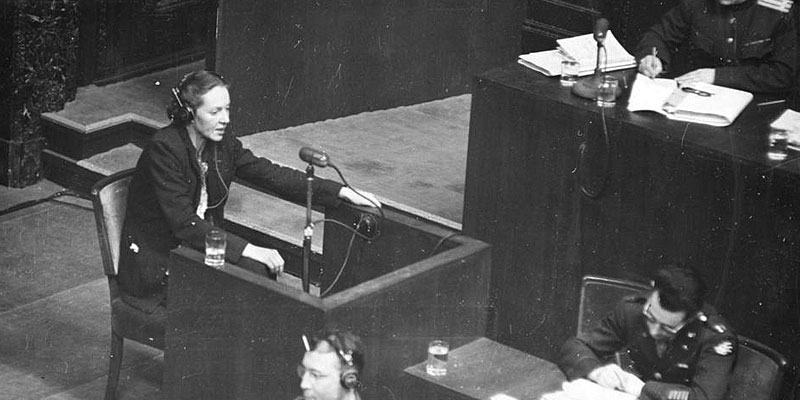
Although documentary evidence formed the foundation of the Allied case, witnesses also appeared before the tribunal. Survivors, resistance members, military officers, government officials and former members of the Nazi system described what they had seen or experienced. French Resistance member and Auschwitz survivor Marie-Claude Vaillant-Couturier gave powerful testimony about deportation, imprisonment, selections and conditions inside Auschwitz and Ravensbrück.
Former German field marshal Friedrich Paulus, who had commanded the German Sixth Army at Stalingrad, appeared as a witness for the Soviet prosecution. His testimony linked senior German military leaders to the planning of the invasion of the Soviet Union.
Witnesses gave a human voice to the documentary record and described the lived reality behind official Nazi language and administration.
Douglas M. Kelley – The Psychiatrist Who Studied the Defendants
Captain Douglas M. Kelley, an American Army psychiatrist, was assigned to examine the mental health and personalities of the principal Nazi defendants held at Nuremberg. His task was to determine whether the accused were mentally competent to stand trial, but his work soon developed into one of the most influential psychological studies of the Nazi leadership.
Kelley interviewed many of the defendants, including Hermann Göring, Rudolf Hess, Joachim von Ribbentrop and Julius Streicher. He also administered intelligence and personality tests. Contrary to expectations, Kelley concluded that many of the leading Nazis showed no signs of insanity or intellectual deficiency. Instead, he found that they were often intelligent, rational individuals who had willingly participated in a criminal regime.
Göring particularly fascinated Kelley. The former Reichsmarschall remained confident, charismatic and intellectually formidable throughout the trial, frequently attempting to dominate both the other defendants and the courtroom itself. Kelley later described Göring as one of the most psychologically complex individuals he had ever examined.
After returning to the United States, Kelley published his observations in 22 Cells in Nuremberg (1947), which remains an important firsthand account of the personalities behind the Nazi leadership. Tragically, on 1 January 1958, Kelley died after taking cyanide in circumstances that echoed Göring's suicide following the Nuremberg verdicts. His death has continued to attract historical interest, although historians have found no evidence that it reflected sympathy for the Nazi defendants.
Douglas Kelley's work demonstrated that many of the leading figures of the Third Reich were not irrational fanatics but psychologically ordinary individuals who consciously chose to participate in extraordinary crimes.
The Allied Cases
The four prosecution teams divided responsibility for different parts of the indictment. Although the cases overlapped, each delegation emphasised the crimes and historical experiences most closely connected to its own country and occupation zone.
The American Case
The American prosecution focused on the Nazi conspiracy and the development of a coordinated plan to seize power, eliminate opposition, rearm Germany and launch aggressive war. The conspiracy charge was intended to connect politicians, military commanders, propagandists, administrators and economic leaders to a broader criminal programme, even when they had not personally carried out acts of violence. The Americans traced the development of the Nazi movement, the destruction of democracy, the persecution of political opponents, the remilitarisation of Germany and the steps leading to the invasions of neighbouring countries.
The American case portrayed Nazi rule as a coordinated system in which different institutions contributed to a wider programme of dictatorship and aggression.
The British Case
The British prosecution presented the principal case concerning crimes against peace. It documented the treaties, guarantees and international agreements violated by Nazi Germany during its successive acts of aggression. The prosecution examined the annexation of Austria, the destruction of Czechoslovakia and the invasions of Poland, Denmark, Norway, Belgium, the Netherlands, Luxembourg, Yugoslavia, Greece and the Soviet Union. British prosecutors argued that these campaigns were not improvised reactions to changing circumstances. They formed part of a deliberate policy through which Nazi Germany intended to dominate Europe by force.
The British prosecution demonstrated that Germany’s wars had emerged from deliberate planning rather than a series of accidental military crises.
The French Case
The French prosecution concentrated on war crimes and crimes against humanity committed in Western Europe. It described the execution of hostages, reprisals against civilians, forced labour, deportation, economic plunder and the persecution of resistance movements. French prosecutors also attempted to explain Nazism as the result of a longer history of extreme nationalism, militarism and pan-German expansionism. Their case placed particular emphasis on the suffering of France, Belgium, Luxembourg and the Netherlands under German occupation.
The French case revealed how occupation became a system of repression, exploitation, deportation and violence against civilian society.
The Soviet Case
The Soviet prosecution documented the enormous scale of destruction caused by the German invasion of the Soviet Union called Operation Barbarossa. Evidence described mass shootings, burned villages, deliberate starvation, deportation for forced labour and the killing or neglect of Soviet prisoners of war. Approximately three million Soviet prisoners of war died in German captivity. Many were deliberately denied adequate food, shelter and medical care because Nazi racial ideology regarded them as inferior and because they were associated with the Soviet state.
The Soviet case was weakened by its attempt to blame Germany for the Katyn massacre, in which thousands of Polish officers and other prisoners had been murdered by the Soviet NKVD in 1940. The German defence challenged the accusation, and the massacre was not included in the tribunal’s final judgment.
Despite the false Soviet accusation concerning Katyn, the broader evidence of German crimes in the occupied Soviet Union was overwhelming.
The Defence Strategies
Each defendant was represented by German legal counsel and was permitted to call witnesses, submit documents, challenge evidence and cross-examine prosecution witnesses. All of the defendants formally pleaded not guilty. Most did not deny that mass atrocities had occurred. Instead, they attempted to distance themselves personally from the crimes or to limit the importance of their roles within the regime.
The defendants received counsel and the opportunity to challenge the case, but the evidence repeatedly tested their attempts to minimise their authority and knowledge.
Blaming Hitler and Other Dead Leaders
A common strategy was to place responsibility on leaders who were no longer alive to defend themselves or contradict the testimony. Hitler’s name was invoked thousands of times as defendants claimed that all important decisions had been made by him alone. Heinrich Himmler and Reinhard Heydrich were similarly blamed for the crimes of the SS, police and security organisations. Defendants frequently portrayed themselves as officials with limited knowledge who had been unable to challenge the orders of more powerful men.
The surviving leaders frequently transferred responsibility to dead or missing figures, while documents demonstrated their own participation in Nazi rule.
Claiming Ignorance
Several defendants claimed that they had not known about the systematic murder of Europe’s Jews or the conditions inside concentration and extermination camps. They argued that the Nazi state had been divided into separate departments and that information about criminal policies had been deliberately concealed. The prosecution countered these claims with official reports, meeting records, correspondence and evidence showing the interconnected nature of the German government, military, economic system and security apparatus.
Official correspondence and administrative records repeatedly undermined claims that senior officials had remained unaware of the regime’s crimes.
Following Orders
Military defendants argued that they had been professional soldiers required to obey the commands of the head of state. The charter, however, had already established that superior orders did not automatically remove personal responsibility. The tribunal considered whether defendants had possessed the authority, knowledge or opportunity to refuse, modify or avoid participation in criminal acts.
Nuremberg established that obedience cannot provide complete protection when an individual knowingly participates in criminal acts.
The Tu Quoque Argument
Defence lawyers attempted to argue that the Allied powers had committed comparable acts. This form of defence, known as tu quoque or “you also”, sought to undermine the prosecution by pointing to Allied bombing, Soviet aggression, population transfers and other controversial actions. The tribunal generally prevented the proceedings from becoming a trial of Allied conduct. It ruled that alleged crimes committed by others did not excuse or legalise crimes committed by the defendants.
One important exception involved German naval commander Karl Dönitz. His defence submitted evidence from United States Admiral Chester Nimitz confirming that American submarines had also conducted unrestricted submarine warfare in the Pacific under certain conditions. Dönitz was still convicted, but the tribunal did not base his sentence on unrestricted submarine warfare against British merchant vessels.
The alleged misconduct of another state could not make the defendants’ own criminal actions lawful.
The Verdicts
The tribunal delivered its judgment on 30 September and 1 October 1946. The judges considered the evidence against each defendant individually rather than treating every member of the Nazi leadership as equally responsible. The judgment declared that aggressive war was the supreme international crime because it contained within itself the accumulated evil of the other crimes that followed.
The tribunal judged the defendants individually, convicting nineteen and acquitting three rather than imposing automatic collective guilt.
Sentenced to Death
Twelve defendants were sentenced to death by hanging:
- Martin Bormann – tried in absentia
- Hans Frank
- Wilhelm Frick
- Hermann Göring
- Alfred Jodl
- Ernst Kaltenbrunner
- Wilhelm Keitel
- Joachim von Ribbentrop
- Alfred Rosenberg
- Fritz Sauckel
- Arthur Seyss-Inquart
- Julius Streicher
Göring requested execution by firing squad rather than hanging, claiming the right to die as a soldier. His request was refused. Late on 15 October 1946, only hours before the executions were scheduled to begin, he committed suicide by taking cyanide. The remaining ten condemned men who were in Allied custody were hanged during the early hours of 16 October 1946. Martin Bormann remained missing and was not executed.
Twelve death sentences were imposed, although Göring died by suicide and Bormann had been tried in absentia.
Sentenced to Imprisonment
Seven defendants received prison sentences:
- Rudolf Hess: Life imprisonment
- Walther Funk: Life imprisonment
- Erich Raeder: Life imprisonment
- Karl Dönitz: 10 years
- Baldur von Schirach: 20 years
- Albert Speer: 20 years
- Konstantin von Neurath: 15 years
The imprisoned defendants were transferred to Spandau Prison in Berlin, which was administered jointly by the four Allied powers.
The prison sentences reflected differing levels of responsibility while still recognising the defendants’ participation in the Nazi system.
Acquitted
Three defendants were acquitted:
- Hans Fritzsche
- Franz von Papen
- Hjalmar Schacht
The acquittals caused public criticism, particularly among people who believed that senior officials who had helped Hitler gain or maintain power should not have been released. Soviet judge Iona Nikitchenko formally dissented from the acquittals and from some of the sentences imposed by the majority.
The three acquittals demonstrated that association with the regime alone was not treated as sufficient proof of individual guilt.
The Criminal Organisations
The tribunal declared four organisational groupings criminal:
- The Leadership Corps of the Nazi Party
- The Gestapo
- The Sicherheitsdienst (SD)
- The Schutzstaffel (SS)
The declarations were limited to members who had joined or remained in the organisations with knowledge that they were being used to commit criminal acts. The tribunal excluded people who had been drafted without genuine choice and those who had not known about or participated in criminal activity. The tribunal did not declare the Reich Cabinet, the SA, or the General Staff and High Command of the German Armed Forces to be criminal organisations.
The decision concerning the German military leadership later contributed to the postwar myth of a “clean Wehrmacht”, according to which the regular German armed forces had fought an honourable conventional war while responsibility for atrocities belonged almost entirely to Hitler and the SS. In reality, extensive historical evidence demonstrates that Wehrmacht units and commanders participated in criminal policies, particularly during the war against the Soviet Union and in occupied Eastern Europe.
The judgment distinguished between criminal organisational structures and the individual guilt of members, which still required knowledge and voluntary participation.
The Subsequent Nuremberg Trials
Held from: 5 December 1946 – 13 April 1949
The International Military Tribunal was intended to be followed by additional joint Allied trials. However, increasing political tension between the Soviet Union and the Western powers made further four-power proceedings impossible. Between 1946 and 1949, the United States conducted twelve additional trials in Nuremberg under Allied Control Council Law No. 10. These proceedings are commonly known as the Subsequent Nuremberg Trials.
A total of 185 defendants were indicted, of whom 177 stood trial. The defendants included doctors, judges, SS officers, government administrators, military commanders, diplomats and industrialists.
The later proceedings demonstrated that responsibility extended beyond the principal leaders to doctors, judges, industrialists, administrators, SS officers and military commanders.
The Doctors’ Trial
Held from: December 9, 1946 to August 20, 1947
The Doctors’ Trial prosecuted physicians and officials accused of conducting medical experiments on concentration camp prisoners and participating in the murder of disabled people through the Nazi euthanasia programme. The judgment contributed to the development of the Nuremberg Code, a set of principles concerning voluntary consent and the ethical conduct of medical experiments involving human participants.
The Doctors’ Trial helped establish lasting principles concerning voluntary consent and the ethical treatment of human research subjects.
Key defendants included:
- Karl Brandt: Hitler's personal physician and Reich Commissioner for Health, who co-headed the Aktion T4 euthanasia program and authorized deadly medical experiments.
- Karl Gebhardt: Himmler's personal doctor and Red Cross President, who conducted brutal surgical and infection experiments on prisoners at Ravensbrück.
- Viktor Brack : A senior SS administrator and a chief organizer of the state euthanasia program, who actively engineered methods for mass forced sterilization.
The Milch Trial
Held from: January 2, 1947 to April 17, 1947
Former Luftwaffe field marshal Erhard Milch was prosecuted for his involvement in forced labour and medical experimentation. He was convicted and sentenced to life imprisonment, although his sentence was later reduced.
The Milch case examined how senior military administration became connected to forced labour and criminal medical experimentation.
Key defendants included:
- Erhard Milch: Field Marshal of the Luftwaffe and former State Secretary of the Reich Aviation Ministry, who was prosecuted for his command role in utilizing forced labor and authorizing freezing and high-altitude human experiments.
The Judges’ Trial
Held from: March 5, 1947 to December 4, 1947
The Judges’ Trial examined the role of judges, prosecutors and Justice Ministry officials in transforming German law into an instrument of persecution and terror. The case demonstrated that lawyers and judges could be held responsible when they deliberately used courts and legislation to facilitate racial persecution, political repression, forced labour and judicial murder.
The case demonstrated that courts and legal officials can become active instruments of persecution when law is subordinated to dictatorship.
Key defendants included:
- Franz Schlegelberger: State Secretary and acting Reich Minister of Justice, who orchestrated the legal degradation of the courts and drafted laws stripped of fundamental human rights.
- Curt Rothenberger: Undersecretary in the Reich Ministry of Justice, who centralized judicial control under the Nazi party and fast-tracked the persecution of minority groups.
- Herbert Klemm: State Secretary in the Reich Ministry of Justice, who actively blocked clemency appeals and authorized the execution of political prisoners and "Night and Fog" detainees.
The Pohl Trial
Held from: April 8, 1947 to November 3, 1947
The Pohl Trial prosecuted senior officials of the SS Main Economic and Administrative Office, which controlled the concentration camp system and exploited prisoner labour. The case revealed the administrative and economic structures that connected concentration camps, forced labour, SS businesses and mass murder.
The Pohl Trial exposed the bureaucracy that linked concentration camps, forced labour, SS administration and economic exploitation.
Key defendants included:
- Oswald Pohl: Head of the SS Main Economic and Administrative Office (WVHA), who managed the financial exploitation of concentration camps and organized the collection of stolen valuables from murdered prisoners.
- Richard Glücks: Chief Inspector of Concentration Camps, who held direct administrative control over the entire camp system and oversaw the implementation of mass extermination facilities.
- August Frank: Deputy Head of the WVHA, who designed the meticulous administrative guidelines for sorting, storing, and laundering the personal belongings stolen from Holocaust victims.
The Flick, IG Farben and Krupp Trials
Held from: April 19, 1947 to July 30, 1948
Three trials focused on leading industrialists and companies accused of exploiting forced and slave labour, plundering occupied territories and supporting the German war economy. The defendants came from the Flick concern, the chemical conglomerate IG Farben and the Krupp industrial empire. The cases raised difficult questions about the responsibility of private companies and business leaders who profited from dictatorship, occupation and forced labour.
The industrialist trials confronted the responsibility of businesses and executives that profited from occupation, plunder and coerced labour.
Key defendants included:
- Friedrich Flick: Head of the Flick Kommanditgesellschaft industrial empire, who aggressively expropriated Jewish-owned businesses through forced "Aryanization" and used thousands of enslaved laborers in his steel mills.
- Otto Steinbrinck: High-ranking executive in the Flick company and SS Brigadier General, who acted as a key administrative pipeline funneling massive corporate funds directly into Heinrich Himmler's projects.
- Konrad Kaletsch: Senior director and chief financial officer within the Flick industrial group, who actively facilitated the financial integration and logistical exploitation of slave labor inside company plants.
- Carl Krauch: Chairman of the IG Farben Supervisory Board, who coordinated industrial production with military demands and approved the massive deployment of slave labor for corporate expansion.
- Otto Ambros: Executive board member and director of the Monowitz concentration camp chemical factory, who oversaw the development of poison gases like Zyklon B and synthetic rubber using enslaved workers.
- Heinrich Bütefisch: Director of gasoline production at IG Farben and SS Obersturmbannführer, who heavily leveraged corporate influence to secure and exploit forced laborers in synthetic fuel production.
The Hostages Trial
Held from: July 8, 1947 to February 19, 1948
The Hostages Trial prosecuted German generals responsible for operations in the Balkans. The evidence concerned the execution of hostages, reprisals against civilians and the destruction of villages in response to partisan activity.
The Hostages Trial examined the limits of military reprisals and the responsibility of commanders for violence against civilians.
Key defendants included:
- Wilhelm List: Field Marshal and commander in the Balkans, who authorized the execution of thousands of innocent civilians and hostages as brutal "retaliation measures" against partisan activities.
- Walter Kuntze: General of Engineers who succeeded List in the Balkans, who aggressively escalated the retaliatory execution quotas, ordering the systematic slaughter of civilians, including women and children.
- Lothar Rendulic: Commander of the 20th Mountain Army, who executed a total "scorched earth" campaign across Finnmark, Norway, completely destroying civilian infrastructure and forcedly evicting populations.
The RuSHA Trial
Held from: October 20, 1947 to March 10, 1948
The RuSHA Trial prosecuted 14 leading officials of the SS Race and Settlement Main Office (RuSHA) and allied organizations responsible for executing the Third Reich’s brutal racial programs. The defendants were convicted of crimes against humanity and war crimes, including the systematic kidnapping of "racially valuable" foreign children for forced Aryanization, the compulsory relocation and ethnic cleansing of non-German populations, and the execution of Nazi population control policies.
The RuSHA Trial exposed how Nazi racial ideology was systematically converted into state-sponsored human trafficking, forced resettlement, and demographic engineering.
Key defendants included:
- Ulrich Greifelt: Chief of the Main Staff of the Reich Commissioner for the Strengthening of Germandom, who directed the systematic displacement, property seizure, and ethnic cleansing of millions of non-Germans.
- Otto Hofmann: Head of the SS Race and Settlement Main Office (RuSHA), who participated in the Wannsee Conference and authorized the forced abortions, racial evaluations, and kidappings of foreign children.
- Richard Hildebrandt: SS Higher Leader and RuSHA Chief, who enforced extreme population control policies, oversaw the brutal repatriation of ethnic Germans, and authorized the murder of disabled individuals.
The Einsatzgruppen Trial
Held from: September 29, 1947 to April 10, 1948
The Einsatzgruppen Trial prosecuted commanders and officers of the mobile killing units that followed the German army into the Soviet Union. The Einsatzgruppen, assisted by other SS, police, military and local collaborationist units, carried out mass shootings of Jews, Roma, Soviet officials and other civilians. The trial was one of the clearest judicial examinations of the systematic mass murder that preceded and accompanied the operation of extermination camps.
The Einsatzgruppen Trial documented organised mass shooting as a central stage in the murder of European Jews and other targeted groups.
Key defendants included:
- Otto Ohlendorf: Commander of Einsatzgruppe D, a highly educated economist who coldly admitted to the systematic murder of over 90,000 people.
- Paul Blobel: Commander of Sonderkommando 4a, responsible for the infamous Babi Yar massacre where over 33,000 people were murdered in two days.
- Heinz Jost: Commander of Einsatzgruppe A, who led the mobile death squads through the Baltic states.
The Ministries Trial
Held from: January 6, 1948 to April 13, 1949
The Ministries Trial examined senior officials from the Foreign Office and other government ministries. It demonstrated how traditional civil servants, diplomats and administrators had helped implement aggression, deportation, occupation and persecution.
The Ministries Trial showed how diplomats and civil servants helped turn political decisions into aggression, deportation and persecution.
Key defendants included:
- Ernst von Weizsäcker: State Secretary in the Foreign Office, who facilitated diplomatic justifications for aggressive warfare and signed off on the deportation of French Jews to Auschwitz.
- Hans Heinrich Lammers: Chief of the Reich Chancellery, who acted as the central administrative hub for Hitler's decrees, legalizing the expropriation of Jewish property and anti-partisan atrocities.
- Gottlob Berger: Chief of the SS Main Office and State Secretary, who commanded military recruitment for the Waffen-SS and oversaw the brutal exploitation of forced labor across occupied territories.
The High Command Trial
Held from: December 30, 1947 to October 28, 1948
The final subsequent trial prosecuted senior German military commanders for war crimes and crimes against humanity. The proceedings examined criminal orders, the treatment of prisoners of war, reprisals and military cooperation with Nazi racial and occupation policies.
The final subsequent trial examined the responsibility of senior commanders for criminal orders and cooperation with Nazi occupation policy.
Key defendants included:
- Wilhelm von Leeb: Field Marshal and Commander of Army Group North during the invasion of the Soviet Union, who transmitted and executed criminal orders such as the "Barbarossa Decree" which led to civilian executions.
- Hugo Sperrle: Field Marshal of the Luftwaffe, who commanded air operations that targeted civilian populations and authorized retaliatory strikes against non-combatants.
- Georg von Küchler: Field Marshal who succeeded Leeb, who actively cooperated with the mobile killing squads (Einsatzgruppen) and enforced the brutal enslavement and starvation of populations in occupied areas.
Reactions in Postwar Germany
Public responses to the Nuremberg Trials were mixed and changed over time. In the immediate aftermath of the war, many Germans were primarily concerned with food shortages, destroyed homes, missing relatives, displacement and survival. Initial opinion surveys indicated that a substantial majority of Germans considered the first Nuremberg trial fair. The presentation of captured documents and film evidence made it difficult to deny that enormous crimes had been committed under Nazi rule.
As the Cold War developed, attitudes changed. By 1950, support for the proceedings had fallen significantly. Increasing numbers of West Germans described the trials as “victors’ justice” or argued that punishment should end so the country could rebuild. Political parties, churches, veterans’ organisations and industrial interests campaigned for clemency and the release of convicted prisoners. These campaigns were influenced by humanitarian concerns, nationalism, personal connections and the desire to reintegrate former officials into West German society.
The Western powers also increasingly viewed West Germany as an essential ally against the Soviet Union. The strategic priorities of the Cold War gradually became more important than the continued punishment of many convicted Nazi officials. In 1951, United States High Commissioner John J. McCloy reviewed sentences imposed during the American-run subsequent trials. Numerous death sentences were commuted and prison terms were reduced.
By 1958, the final prisoners convicted in the Subsequent Nuremberg Trials had been released from Landsberg Prison. The prisoners sentenced by the original International Military Tribunal were held separately at Spandau Prison.
As Cold War priorities changed, political pressure for clemency increasingly competed with the original determination to punish Nazi crimes.
The Long-Term Legal Legacy
The Nuremberg Trials transformed international law by establishing that individuals could be held criminally responsible for actions committed on behalf of a state. Government authority, military rank and official orders could no longer provide complete protection from prosecution. On 11 December 1946, the United Nations General Assembly unanimously adopted Resolution 95(I), affirming the principles of international law recognised in the Nuremberg Charter and judgment.
Nuremberg established that international crimes are committed by individuals and that public office does not place their perpetrators beyond legal accountability.
The Nuremberg Principles
The principles associated with the tribunal established that:
- An individual who commits a crime under international law is personally responsible and may be punished.
- National law does not remove responsibility when an act is criminal under international law.
- Heads of state and government officials are not immune from responsibility under international law.
- Acting under superior orders does not remove responsibility when a moral choice was possible.
- Anyone charged with an international crime is entitled to a fair trial.
- Crimes against peace, war crimes and crimes against humanity are punishable under international law.
- Complicity in the commission of these crimes is itself a crime under international law.
The principles converted the central lessons of the tribunal into a lasting framework of individual responsibility under international law.
The Genocide Convention
The work of the tribunal contributed to the international movement to define and prevent genocide. Polish-Jewish jurist Raphael Lemkin had created the term “genocide” during the war to describe the intentional destruction of national, ethnic, racial or religious groups. On 9 December 1948, the United Nations adopted the Convention on the Prevention and Punishment of the Crime of Genocide. The convention recognised genocide as an international crime committed in peacetime or wartime.
The Genocide Convention extended the postwar legal response by recognising the intentional destruction of protected groups as an international crime.
Later International Tribunals
For several decades after Nuremberg, the creation of a permanent international criminal court remained blocked by Cold War political divisions. Nevertheless, the legal ideas developed at Nuremberg continued to influence international treaties, military law and national prosecutions. During the 1990s, the United Nations established international criminal tribunals for the former Yugoslavia and Rwanda. These courts prosecuted individuals for genocide, war crimes and crimes against humanity. The Nuremberg legacy also influenced the creation of the permanent International Criminal Court, which began operating in 2002 after the entry into force of the Rome Statute.
The tribunals for the former Yugoslavia and Rwanda, followed by the International Criminal Court, carried key elements of the Nuremberg legacy into later generations.
Principal Figures
Robert H. Jackson
Robert H. Jackson was an associate justice of the United States Supreme Court and served as chief prosecutor for the United States at Nuremberg. He played a leading role in negotiating the tribunal’s charter and insisted that aggressive war should be prosecuted as an international crime. His opening and closing statements became among the best-known speeches in the history of international law.
Jackson’s central objective was to create a trial whose documentary evidence and procedures could withstand the judgment of history.
Sir Geoffrey Lawrence
Sir Geoffrey Lawrence was the principal British judge and president of the International Military Tribunal. He presided over the courtroom, managed disputes between the participating legal systems and formally announced the tribunal’s judgments and sentences.
Lawrence’s careful presidency helped preserve order and judicial credibility throughout an unprecedented multinational proceeding.
Roman Rudenko
Roman Rudenko served as chief prosecutor for the Soviet Union. He presented evidence concerning the German invasion and occupation of Soviet territory, including mass killings, the destruction of communities and the treatment of Soviet prisoners of war.
Rudenko’s case placed the catastrophic human cost of the German occupation of the Soviet Union before the tribunal.
Hartley Shawcross
Hartley Shawcross was the chief British prosecutor. His team presented much of the case concerning crimes against peace and the sequence of treaties, threats and invasions through which Nazi Germany launched aggressive war.
Shawcross and the British team connected Germany’s successive invasions to a deliberate programme of aggressive war.
Hermann Göring
Hermann Göring was the highest-ranking surviving Nazi leader placed on trial. A leading figure in the regime from its earliest years, he had served as commander-in-chief of the Luftwaffe and held numerous political and economic offices. He was convicted on all four counts and sentenced to death, but committed suicide before his execution.
As the highest-ranking surviving Nazi leader, Göring became the most prominent symbol of the regime placed before the tribunal.
Joachim von Ribbentrop
Joachim von Ribbentrop served as Nazi Germany’s foreign minister. He played an important role in diplomatic agreements, threats and policies connected to German expansion and aggressive war. He was convicted on all four counts and executed on 16 October 1946.
Ribbentrop’s conviction reflected the role of diplomacy in preparing, threatening and enabling Nazi Germany’s expansion.
Ernst Kaltenbrunner
Ernst Kaltenbrunner became chief of the Reich Security Main Office after Reinhard Heydrich’s death. His position placed him over the Gestapo, SD and security organisations deeply involved in persecution, deportation and mass murder. He was sentenced to death and executed.
Kaltenbrunner’s position connected him directly to security organisations involved in deportation, persecution and mass murder.
Arthur Seyss-Inquart
Arthur Seyss-Inquart played an important role in the annexation of Austria and later served as Reich Commissioner for the occupied Netherlands. During his administration, Dutch Jews were persecuted and deported, while forced labour and reprisals were imposed on the population. He was sentenced to death and executed.
Seyss-Inquart’s conviction reflected his role in annexation, occupation and the persecution and deportation of Dutch Jews.
Albert Speer
Albert Speer served as minister of armaments and war production. His ministry greatly expanded German weapons production through the extensive use of foreign forced labour and concentration camp prisoners. He accepted a general form of responsibility for the regime but denied detailed knowledge of the Holocaust. He was sentenced to 20 years in prison.
Speer’s carefully constructed image of limited responsibility has remained the subject of sustained historical scrutiny.
Principal Figure

Principal Figure

Principal Figure

in-depth information.