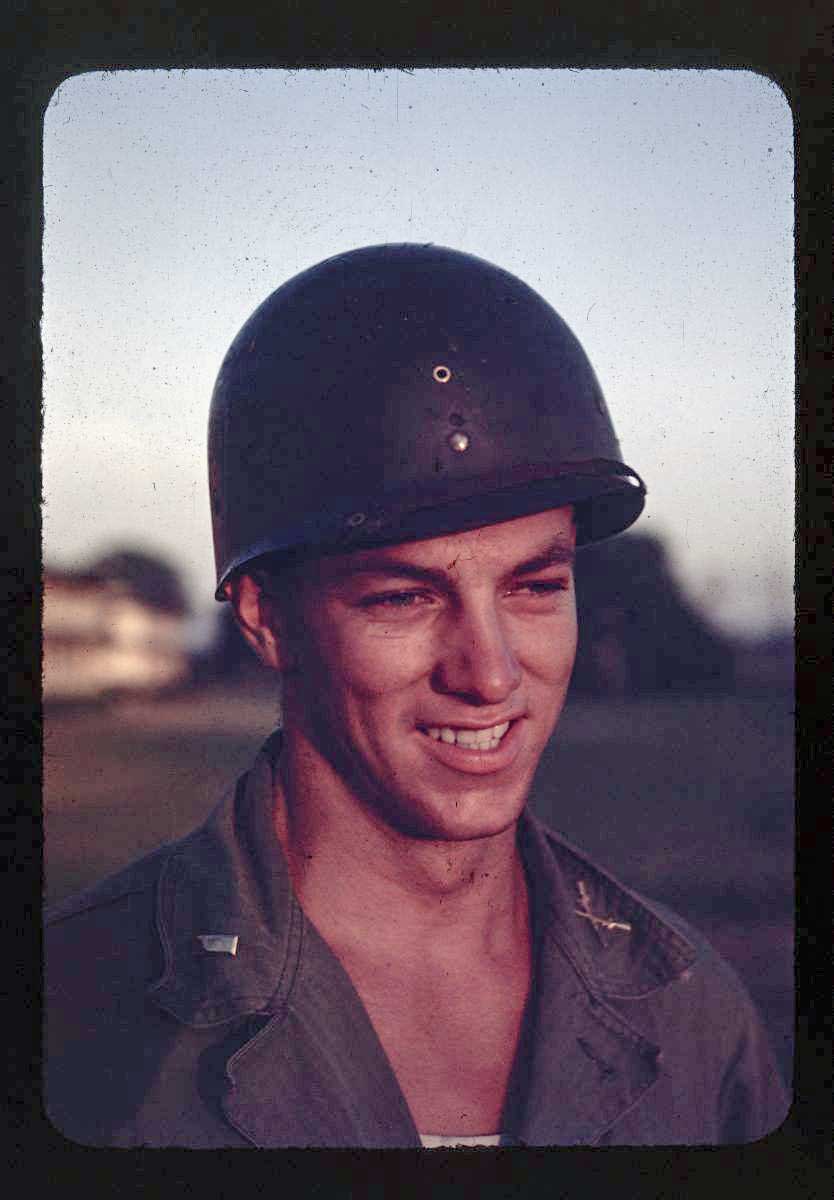
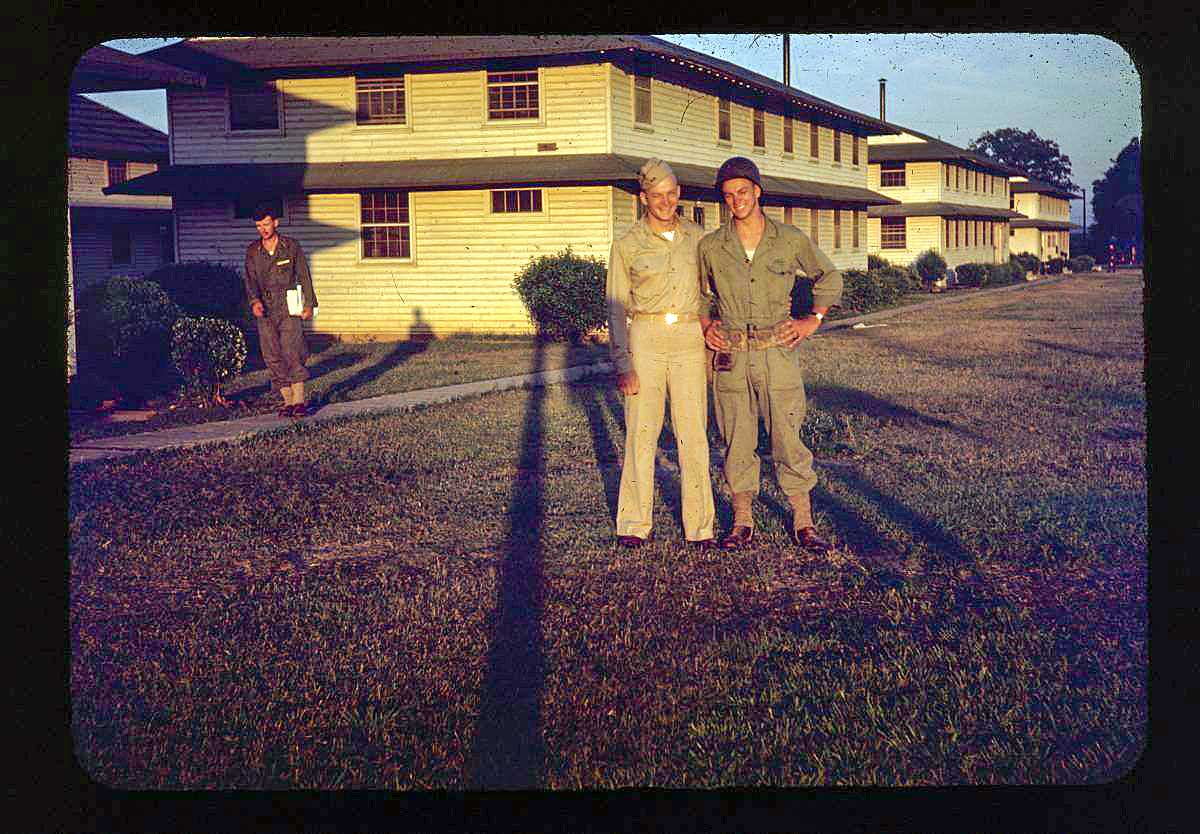
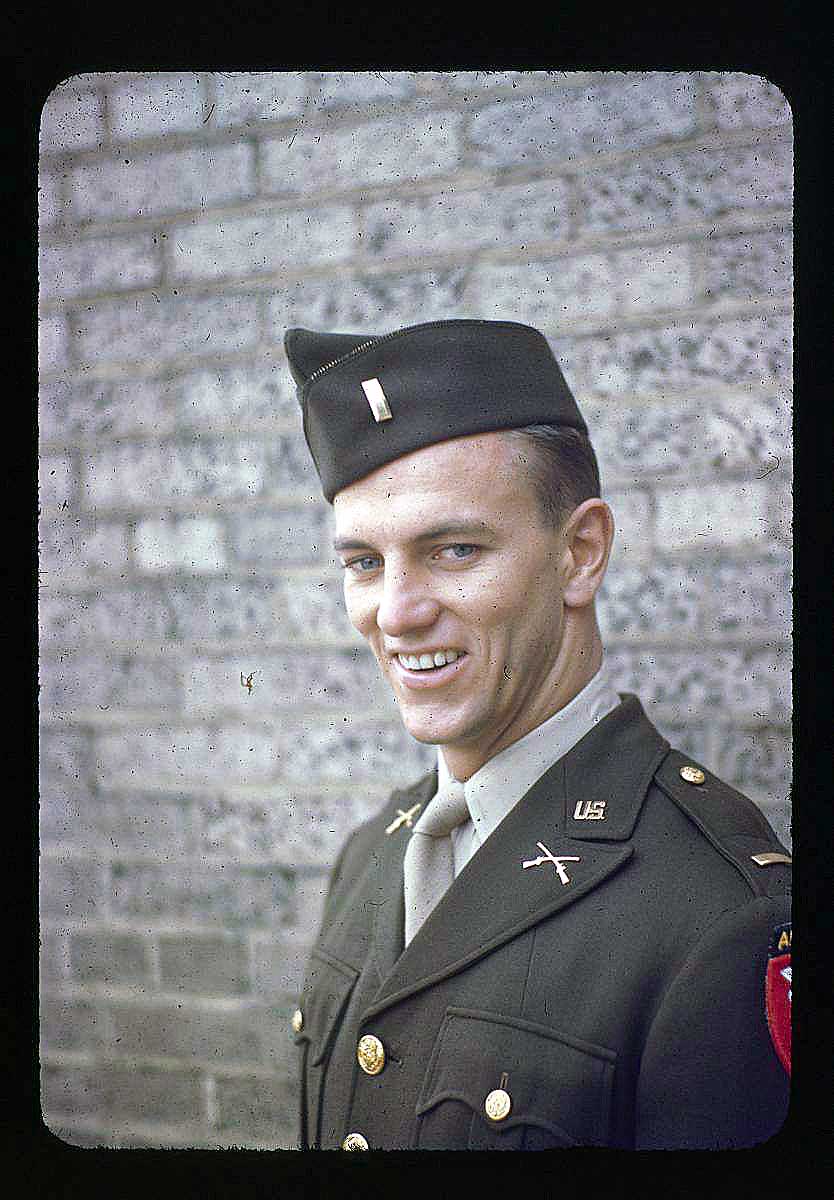
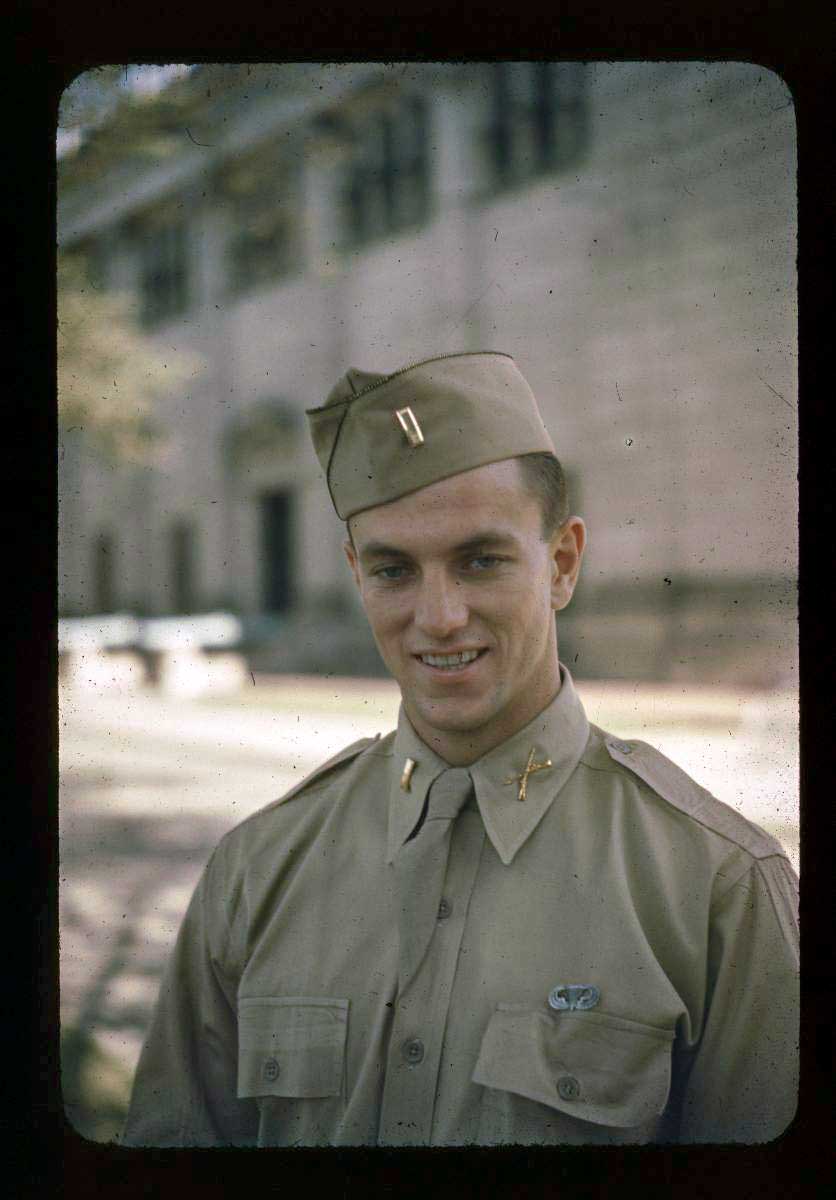
First Lieutenant John Rutherford Thompson, O-532287, served with Company F, 506th Parachute Infantry Regiment, 101st Airborne Division. He was wounded at Bastogne on December 22, 1944. Dr. John R. Thompson's journey through the Second World War was preserved by his wife, the late Irene Hansen Thompson, using hand-selected letters John sent home together with a biography she composed. More than 150 of John's letters, envelopes and cards from 1942 to 1946 survived, along with photographs from the family Kodachrome collection.
In Irene's words
John was born on April 16, 1921, in University Place, a suburb of Lincoln, Nebraska. Irene remembered that he was very involved in athletics from high school through university. He played football and competed in track, but was especially known as an outstanding basketball player at the University of Nebraska. She described him as a natural athlete, “not tall but fast,” always with a smile on his face, a member of the N Club and a four-letter man.
While studying at the University of Nebraska, John was a member of ROTC. During his senior year he lived in Love Library, which had recently been built but was then being used as accommodation for ROTC air cadets and Army Specialized Training Program students preparing for officer training. His graduation was moved forward, and he left for officer training.
Camp Hood, Texas – August 1943
In August 1943, Corporal John Thompson wrote to his parents from Tank Destroyer School at Camp Hood, Texas. His letters reveal the humor with which he often described Army life. He told them that “the picture above is absolutely false,” because there was not a tank in sight, no mountains or even hills, few trees, and only sparse grass covering the ground. John did not think the mental or physical work would trouble him much. Instead, he joked that the one thing that might get them thrown out would be “the discipline angle,” if they accidentally got on the wrong side of an officer.
He also confirmed something his father had apparently warned him about: the water. “Dad you really told the truth about the water down here,” John wrote. “It’s the worst I ever tasted and its always warm.” He added that the water coming from the fountain was warm enough to shower in. The heat was intense, but to him it somehow felt drier than expected.
Fort Benning, Georgia – May 1944
By May 1944, John was a Second Lieutenant attending Infantry School at Fort Benning, Georgia. Writing to his brother, he described finally seeing places he had known only from maps at the University of Nebraska, including Maxey Ridge and Lumpkin Road. The course was, as he put it, “strictly basic infantry.” It began with map reading and then moved on to weapons training, starting with the M1 rifle. John also described an azimuth and aerial photograph exercise in which he hit both stations “on the nose” and returned to barracks two hours early.
Parachute School – July 1944
On July 24, 1944, John wrote from Parachute School at Fort Benning. He reported that around 200 men out of 600 had quit during tower training. His own description of the tower was simple: “It’s a b---- and just like a circus.” By then, his jump training was almost complete. He had already made three jumps and had only two left: one with full equipment and a final night jump. John's account of his first jump was full of the same matter-of-fact humor found throughout his letters. He wrote that the first jump was exciting, but that he could truthfully say he had not been scared because he trusted his packing.
He was also very clear that he had not done everything correctly. His counting stopped at one thousand instead of three thousand. He almost went into a front tumble before the parachute opened, turned completely around until he was facing the aircraft, came out with a twist in his suspension lines, and then missed the field.
Even so, he wrote that he “lit like a feather.” He narrowly missed another lieutenant, a medic, by about a foot and a half. The medic had jumped behind him but still reached the ground first. John noted that the man was a big fellow and added, with typical humor, “He lit like a sack.”
Mourmelon-le-Grand, France – Late November 1944
By late November 1944, John was at Mourmelon-le-Grand, France. He wrote that he had not had much opportunity to visit nearby towns, although he had been to a place he called “Rense,” adding that he thought that was the spelling and that it was pronounced “Reams.” He was referring to Reims. He mentioned the champagne produced there, describing it in his own understated way as being “about like strong gingerale.”
More importantly, John wrote that he was then serving as an acting company commander. He did not yet have a full company, but expected the rest of his men to arrive over the following week or two. Some of the men joining his outfit had just returned from the front. John observed that they were “plenty glad to be here.”
122nd General Hospital, England – January 5, 1945
On January 5, 1945, John wrote from the 122nd General Hospital in England. By then, he had been wounded at Bastogne on December 22, 1944. One of the first things he mentioned was the Purple Heart. “Well Thebes they’re trying to hang the Purple Heart on me today,” he wrote. “I told them I didn’t think I deserved it and I still don’t.”
John believed that he may have been hit by an observation post from the 501st Parachute Infantry Regiment. He had not seen who fired the shots, but someone had been able to reach him quickly and carry him to a farmhouse. He reasoned that, had a sniper been responsible, it might not have been possible for others to get to him so quickly.
Because the Purple Heart was awarded for wounds resulting from enemy action, John questioned whether he should receive it. “I don’t think I’ll wear it if I get it,” he wrote.
Wounded at Bastogne
John described his wounds plainly. One projectile struck just below the collarbone, slightly to the right of the center of his chest, and exited through the right side of his back. The other was, in his words, “an in-and-out job” through the right thigh without breaking any bones. “That was the 22 at Bastogne,” he wrote.
Despite the seriousness of the wounds, John was already thinking about recovery. He could stand for short periods on his leg and felt that his breathing was improving. He believed he was making good progress and hoped to be back with his outfit by the end of January or the middle of February.
The cold and artillery at Bastogne
John also described the conditions he had experienced around Bastogne. “The snow and cold up there is really rough,” he wrote. During the time he was there, the men had no bedrolls, overcoats or overshoes. A slit trench covered with pine boughs gave some protection from the cold and snow, but many of the soldiers were suffering from trench foot.
He was also struck by the weight of German artillery. John described self-propelled guns and the feared 88 mm gun. The 88s were especially dangerous because, unlike other artillery, there was often no warning. “It’s just a bang and ‘you’ve had it’ as they say,” he wrote.
German automatic weapons also made an impression on him. He mentioned “burp-guns,” machine pistols and machine guns and noted the tremendous volume of fire they could produce.
“I’m no old battle veteran”
Despite what he had already seen, John made a point of telling his brother that he was “no old battle veteran.” In fact, he admitted that he still did not know what it was all about. He then wrote about seeing men killed and about the way soldiers at the front learned to deal with death. When someone was killed, John said, the reaction was often little more than: “damn it and he was a swell guy and soldier,” and then life at the front went on.
His conclusion was stark. “Sooner or later if you stay up there and do your job you’re going to get it,” he wrote. “You don’t think about it but its bound to happen.” John was careful to explain that he did not intend to sound cowardly or frighten anyone. It was simply, he said, “a plain statement of the fact and all the boys agree.”
After everything he had written about wounds, cold, artillery and death, he ended the letter simply: “Well Thebes Happy New Year and I’ll write you soon. Love, John.”
In Irene's words
Irene later described what happened after John was wounded. He was transported across France in an ambulance carrying six men. Two of them died during the journey. When John eventually reached England and was admitted to hospital, doctors discovered that his lung had collapsed. Irene recalled that he was in considerable pain and that very little could initially be done for him, but he survived.
He was later shipped back to the United States and admitted to a hospital in Spokane, Washington.
John and Irene
While John was home on leave in May 1945, he and Irene had their first date. He later returned to Spokane, but managed to obtain enough gasoline ration stamps to travel with his parents to his beloved family cabin in Minnesota. There, his recovery continued. John eventually left military service as a First Lieutenant and recipient of the Purple Heart. Irene later recalled that he would continue to suffer from horrible nightmares and, for a time, severe attacks of asthma.
John and Irene continued dating and set their wedding date for June 12, 1946.
A life after the war
John had graduated from the University of Nebraska in 1943 with a degree in geology. After the war, he continued his education and graduated from the University of Nebraska Medical School in 1952 with his medical degree. He went on to practice medicine and delivered more than 500 babies in Auburn, Nebraska. He later practiced medicine in Lincoln until his retirement in 1989.
The letters survived
The letters used in this story were selected by Irene from a collection of more than 150 of John's letters, envelopes and cards written between 1942 and 1946. Together with the family's Kodachrome photographs, they preserve the story of a young Nebraskan who became an officer, a paratrooper and a combat veteran. More importantly, they preserve John's own voice: humorous, modest, observant and remarkably matter-of-fact even when writing about fear, wounds and death. Because John wrote home, and because Irene preserved his words, First Lieutenant John Rutherford Thompson can still tell part of his own story today.
Thank you to John and Irene's family and Drew for providing the material.