2nd Infantry Division
World War I origins
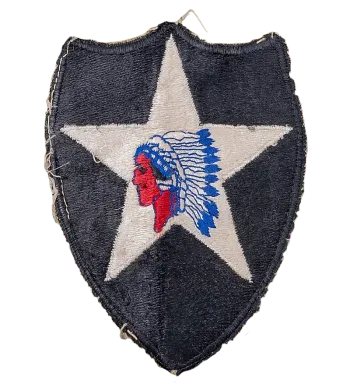
The 2nd Division was organized in 1917 as part of the American Expeditionary Forces during World War I. The division is known as the “Indianhead Division”, derived from its distinctive shoulder insignia featuring a Native American profile. It was a unique combined formation consisting of both U.S. Army and U.S. Marine Corps units. Its infantry component included the Army’s 3d Infantry Brigade and the 4th Marine Brigade, composed primarily of the 5th Marine Regiment and 6th Marine Regiment, supported by the 6th Machine Gun Battalion.
The division saw extensive combat in 1918, including at Belleau Wood, Soissons, Saint-Mihiel, and during the Meuse–Argonne Offensive, establishing a reputation as one of the most effective American divisions of the war. Its actions at Belleau Wood became one of the most celebrated engagements in the history of the United States Marine Corps. During World War II, the 2nd Infantry Division was an entirely U.S. Army formation and did not include Marine Corps units.
Early history
Following its pre-war service, the division was reorganized and expanded as part of the United States Army’s mobilization for World War II. The 2nd Infantry Division had a distinguished lineage dating back to the First World War, where it served as one of the original American Expeditionary Forces divisions in France.
In the early years of World War II, the division trained extensively in the United States, participating in large-scale maneuvers designed to prepare U.S. forces for modern combat operations. The division departed for overseas service on 8 October 1943 from the New York Port of Embarkation and arrived in Northern Ireland on 17 October 1943, where it continued training and conducted preparations for operations in northwest Europe. The division completed its training in Northern Ireland and England before participating in operations in Normandy.
Command Chronology
Rank Commander Period
Major General Walter M. Robertson
May 1942 – Jun 1945
Order of Battle
This technical list represents the core structure of the division during its operations in the European Theater.
Infantry Regiments
- 9th Infantry Regiment
- 23rd Infantry Regiment
- 38th Infantry Regiment
Division Artillery
- 12th Field Artillery Battalion
- 15th Field Artillery Battalion
- 37th Field Artillery Battalion
- 38th Field Artillery Battalion
Reconnaissance and Support Units
- 2nd Reconnaissance Troop (Mechanized)
- 2nd Engineer Combat Battalion
- 2nd Medical Battalion
- 2nd Signal Company
Additional Division Units
- 702nd Ordnance Light Maintenance Company
- 2nd Quartermaster Company
- Military Police Platoon
- Band
World War II: Normandy Campaign
Assigned to V Corps under First U.S. Army, the division completed its training in the United Kingdom before participating in operations in Normandy.
Arrival at Omaha Beach
Advance elements of the division began landing late on 6 June 1944, with the main body coming ashore on 7 June (D+1) at Omaha Beach near Saint-Laurent-sur-Mer. Its mission was to reinforce the beachhead and expand the Allied lodgment inland. Following the landing, the division advanced into the bocage terrain, where dense hedgerows, narrow roads, and limited visibility favored German defensive tactics and slowed Allied progress.
Advance inland and the Battle for Hill 192
The division secured Trévières on 10 June 1944 and advanced toward Saint-Lô, a key communications center in the German defensive system. Its advance was opposed by elements of German formations including the 3rd Parachute Division and Panzer Lehr Division. Hill 192, one of the most heavily contested objectives in the sector, dominated the surrounding terrain and provided German forces with critical observation over Allied positions.
Units of the 9th and 38th Infantry Regiments engaged in sustained combat throughout June and early July. On 11 July 1944, after coordinated infantry, armor, and artillery operations, the division captured Hill 192. This success denied German forces a critical observation position and significantly improved Allied artillery effectiveness in the sector.
The capture of Hill 192 marked a turning point in the division’s sector and contributed directly to the success of the subsequent breakout from Normandy.
Breakout from Normandy
Following the launch of Operation Cobra on 25 July 1944, German defensive cohesion in Normandy deteriorated. The 2nd Infantry Division continued offensive operations, advancing across the Vire River and maintaining pressure on withdrawing German forces. On 15 August 1944, the division captured Tinchebray as Allied forces expanded the breakout and advanced across France.
Continued operations in Northwest Europe (1944–1945)
Brest and Brittany operations
The division subsequently moved west to assist in the reduction of the fortified port of Brest. German forces defended the city as a fortress, and it fell on 18 September 1944 after prolonged fighting. The division then entered a short rest period before redeploying to the eastern front.
Ardennes offensive and Elsenborn Ridge
The division took up defensive positions near Saint-Vith. During the German Battle of the Bulge in December 1944, it withdrew to defensive positions along the Elsenborn Ridge. There, the division played a key role in halting the German advance. The defense of Elsenborn Ridge was critical in stabilizing the northern sector of the Ardennes front.
Counteroffensive and advance to the Rhine
In February 1945, the division resumed offensive operations, recapturing lost ground and advancing into Germany. It captured Gemünd on 4 March and reached the Rhine River on 9 March. Continuing south, the division secured Bad Breisig between 10 and 11 March and was assigned to guard the Ludendorff Bridge at Remagen from 12 to 20 March, ensuring the security of a key Allied crossing.
Crossing the Rhine and advance into central Germany
The division crossed the Rhine on 21 March 1945 and advanced into central Germany. It captured Hadamar and Limburg an der Lahn, relieving elements of the 9th Armored Division on 28 March.
Continuing the advance, the division:
- Crossed the Weser River near Veckerhagen (6–7 April)
- Captured Göttingen on 8 April
- Established a bridgehead across the Saale River on 14 April
- Captured Merseburg on 15 April
Final Operations: Leipzig and the end of the war
On 18 April 1945, the division captured Leipzig after urban combat and conducted mopping-up operations in the surrounding area. It advanced to the Mulde River, where forward elements briefly crossed before being withdrawn on 24 April in accordance with Allied operational boundaries.
In early May, the division moved to positions along the German–Czechoslovak border near Schönsee and Waldmünchen, advancing toward Plzeň (Pilsen) as hostilities in Europe came to an end on 8 May 1945.
Operational significance
From Normandy to central Europe, the 2nd Infantry Division participated in all major phases of the campaign in northwest Europe:
- Reinforcement and expansion of the Normandy beachhead
- Attritional combat in the bocage
- Breakout and pursuit across France
- Reduction of fortified positions
- Defensive operations during the Ardennes Offensive
- Counteroffensive into Germany
- Crossing of the Rhine and final advance into central Europe
The division’s sustained combat effectiveness across both offensive and defensive operations played a significant role in the defeat of German forces in Western Europe.
The combat record of 2nd Infantry Division reflects its role as a key assault and maneuver formation in the European Theater:
- 22 October 1943: Attached to First Army
- 24 December 1943: XV Corps, but attached to First Army
- 14 April 1944: V Corps, First Army
- 1 August 1944: V Corps, First Army, 12th Army Group
- 17 August 1944: XIX Corps
- 18 August 1944: VIII Corps, Third Army, 12th Army Group
- 5 September 1944: VIII Corps, Ninth Army, 12th Army Group
- 22 October 1944: VIII Corps, First Army, 12th Army Group
- 11 December 1944: V Corps
- 20 December 1944: Attached, with the entire First Army, to the British 21st Army Group
- 18 January 1945: V Corps, First Army, 12th Army Group
- 28 April 1945: VII Corps
- 1 May 1945: V Corps
- 6 May 1945: Third Army, 12th Army Group
United States Army Center of Military History
United States Army in World War II (“Green Books” series), U.S. Army official history
Second to none
Specific information for this unit

Unit awards of the 2nd Infantry Division


Maj. Gen. John C. H. Lee

Maj. Gen. Walter M. Robertson

Brig. Gen. William K. Harrison

Maj. Gen. Edward M. Almond
Cite this historical page
