
Who was Viktor Lutze?
Viktor Lutze was a senior Nazi Party official and the successor to Ernst Röhm as Chief of Staff of the Sturmabteilung (SA). Although he never achieved the prominence or influence of Röhm, Lutze played an important role in reshaping the SA after the Night of the Long Knives in 1934, when Adolf Hitler ordered the purge of the organisation's leadership. Loyal to Hitler and committed to the Nazi regime, Lutze spent much of his career overseeing the reduced and increasingly ceremonial role of the SA during the years leading up to and during the Second World War.
Quick Facts
Full name: Viktor Lutze
Born: 28 December 1890, Bevergern, German Empire
Died: 2 May 1943, Potsdam, Germany
Age at death: 52
Rank: SA-Obergruppenführer
Organization: Sturmabteilung (SA)
Political party: National Socialist German Workers' Party (NSDAP)
Known for: Succeeding Ernst Röhm as Chief of Staff of the SA after the Night of the Long Knives
Years as SA Chief: 1934–1943
Historical significance: Led the SA after its political power was curtailed and transformed it into a subordinate organisation within the Nazi state
Early Life and First World War
Viktor Lutze was born on 28 December 1890 in Bevergern, in the German Empire. He was raised in a working-class family and later worked as a civil servant in the railway service. During the First World War, Lutze served in the German Army on the Western Front, where he was wounded in action. For his military service, he received both the Iron Cross 2nd Class and the Iron Cross 1st Class.
Like many German veterans, the defeat of 1918, the collapse of the German Empire and the political instability that followed had a lasting impact on his views. These experiences contributed to his later involvement in nationalist politics and the growing National Socialist movement.
Personal life
Viktor Lutze was married to Paula Lutze and had a daughter Inge (who died in the 1943 car accident that also killed him) and two sons Addi and Viktor Jr. Unlike some other leading figures in Nazi Germany, he did not cultivate a prominent public image outside his political and paramilitary roles. Lutze was considered a loyal supporter of Adolf Hitler and maintained a lower public profile compared to his predecessor Ernst Röhm.
His life was largely defined by his work within the SA and his political responsibilities in the Third Reich.
Rise within the Nazi Party
After the war, Lutze became involved in nationalist movements. He joined the National Socialist German Workers’ Party (NSDAP) in 1922 and became a member of the Sturmabteilung (SA) in 1923, the party’s paramilitary organization.
Lutze established himself as a loyal supporter of Adolf Hitler and rose steadily within the SA. He played an important role in organizing the movement in northern Germany and was elected to the Reichstag in 1930, a position he held until his death.
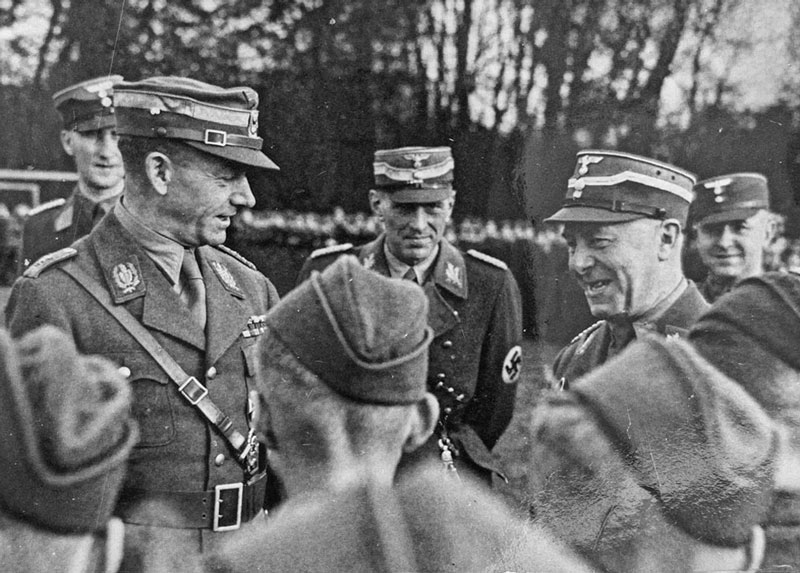
Viktor Lutze is on the left in this picture
Picture: Landon Terry, used with permission
Rising tension between Nazi leadership and the SA
By 1934, tensions within the Nazi leadership had reached a critical point. Viktor Lutze aligned himself with Adolf Hitler and informed him about SA leader Ernst Röhm, whose growing power and ambitions alarmed both the Reichswehr and the Nazi leadership.
Role during the Night of the Long Knives
During the purge known as the Night of the Long Knives, between 30 June and 2 July 1934, Röhm and other SA leaders were arrested and executed. Following these events, Lutze was appointed by Hitler as the new Chief of Staff of the SA.
Leadership of the SA
As Chief of Staff, Lutze was tasked with restructuring the SA and bringing it firmly under Hitler’s control. Unlike Röhm, he did not seek to challenge the authority of the German Army or expand the SA’s political power. Under Lutze, the SA rapidly lost political influence, while the Schutzstaffel (SS), under Heinrich Himmler, became the dominant force within Nazi Germany. The SA continued to exist, but its role was largely reduced to training, propaganda, and ceremonial functions.
Role in major Nazi actions
Although its influence declined after 1934, the SA remained involved in Nazi activities. During Kristallnacht on 9 – 10 November 1938, SA units participated in coordinated attacks against Jewish businesses, homes and synagogues across Germany and Austria.
Second World War
During the Second World War, Lutze remained the formal head of the SA, but his position was largely symbolic. Real power within Nazi Germany was exercised by the Wehrmacht and the SS. The SA played only a limited role during the war and was primarily used for auxiliary and support functions.
Death
Viktor Lutze was seriously injured in a car accident on 1 May 1943 near Potsdam and died the following day, on 2 May 1943, from his injuries. His daughter, who was in the same car, was also killed in the accident. The Nazi regime organized a state funeral, using his death for propaganda purposes.
Historical significance
Viktor Lutze played a key role in consolidating Adolf Hitler’s power after the Night of the Long Knives. His loyalty and willingness to subordinate the SA ensured that the organization no longer posed a threat to the Nazi leadership.
His leadership marked the transformation of the SA from a powerful paramilitary movement into a subordinate institution within the Third Reich, as power shifted decisively to the SS and the German military establishment.
Key Dates
28 December 1890: Born in Bevergern, Province of Westphalia, German Empire.
1912: Volunteered for service in the Imperial German Army.
August 1914: Served in the German Army during the First World War.
1922: Joined the National Socialist German Workers' Party (NSDAP).
1923: Joined the Sturmabteilung (SA).
1931: Appointed SA-Gruppenführer for the Hanover region.
30 June 1934: Supported Adolf Hitler during the Night of the Long Knives by assisting in the removal of Ernst Röhm and other SA leaders.
1 July 1934: Appointed Stabschef (Chief of Staff) of the SA, succeeding Ernst Röhm.
1935: Elected to the Reichstag and continued reorganising the SA under Hitler's direction.
2 May 1943: Seriously injured in a motor vehicle accident near Potsdam.
26 May 1943: Died in Berlin from injuries sustained in the accident at the age of 52.


Cite this historical page
