
Commanders of the Operation Market Garden


What was Operation Market Garden?
Operation Market Garden (17 - 25 September 1944) was a major Allied military operation in the Netherlands during the Second World War. The operation combined one of the largest airborne operations of the Second World War with a large-scale ground offensive designed to create a direct route into northern Germany.
The plan was developed primarily by Field Marshal Bernard Montgomery following the Allied breakout from Normandy and the rapid advance across France and Belgium during the summer of 1944. Montgomery hoped to bypass the heavily fortified German Siegfried Line, cross the Rhine River, and open a path into Germany’s industrial Ruhr region.
The Allied advance after Normandy
After the liberation of Paris and the collapse of German positions in France, Allied forces advanced rapidly across Western Europe. However, growing supply shortages and stretched logistics slowed the Allied momentum by September 1944.
At the same time, disagreements emerged among Allied commanders regarding strategy. Many American commanders favored advancing along a broad front across the Western Front, while Montgomery argued for a concentrated offensive through the Netherlands and into Germany.
The plan for Market Garden
Operation Market Garden consisted of two connected operations: Operation Market, the airborne assault, and Operation Garden, the ground offensive.
The airborne phase involved the First Allied Airborne Army under Lieutenant General Lewis H. Brereton. The operation aimed to capture a series of bridges across rivers and canals in the Netherlands before German forces could destroy them.
The U.S. 101st Airborne Division was assigned to capture bridges around Eindhoven, while the U.S. 82nd Airborne Division targeted crossings near Nijmegen. The British 1st Airborne Division, supported by the Polish 1st Independent Parachute Brigade, received the most ambitious objective: securing the bridge across the Lower Rhine at Arnhem.
At the same time, the British XXX Corps, commanded by Lieutenant General Brian Horrocks, would advance north from Belgium along a narrow corridor through the Netherlands and link up with the airborne troops.
The success of the operation depended heavily on speed, coordination, maintaining momentum along the narrow Allied advance corridor and the rapid capture of each bridge along the route.
1st Airborne Division

10. SS-Panzer-Division Frundsberg

Battle specifications
Date of the battle
Duration of the battle
Reason for the battle
Location
Battle result


The Battle of Arnhem
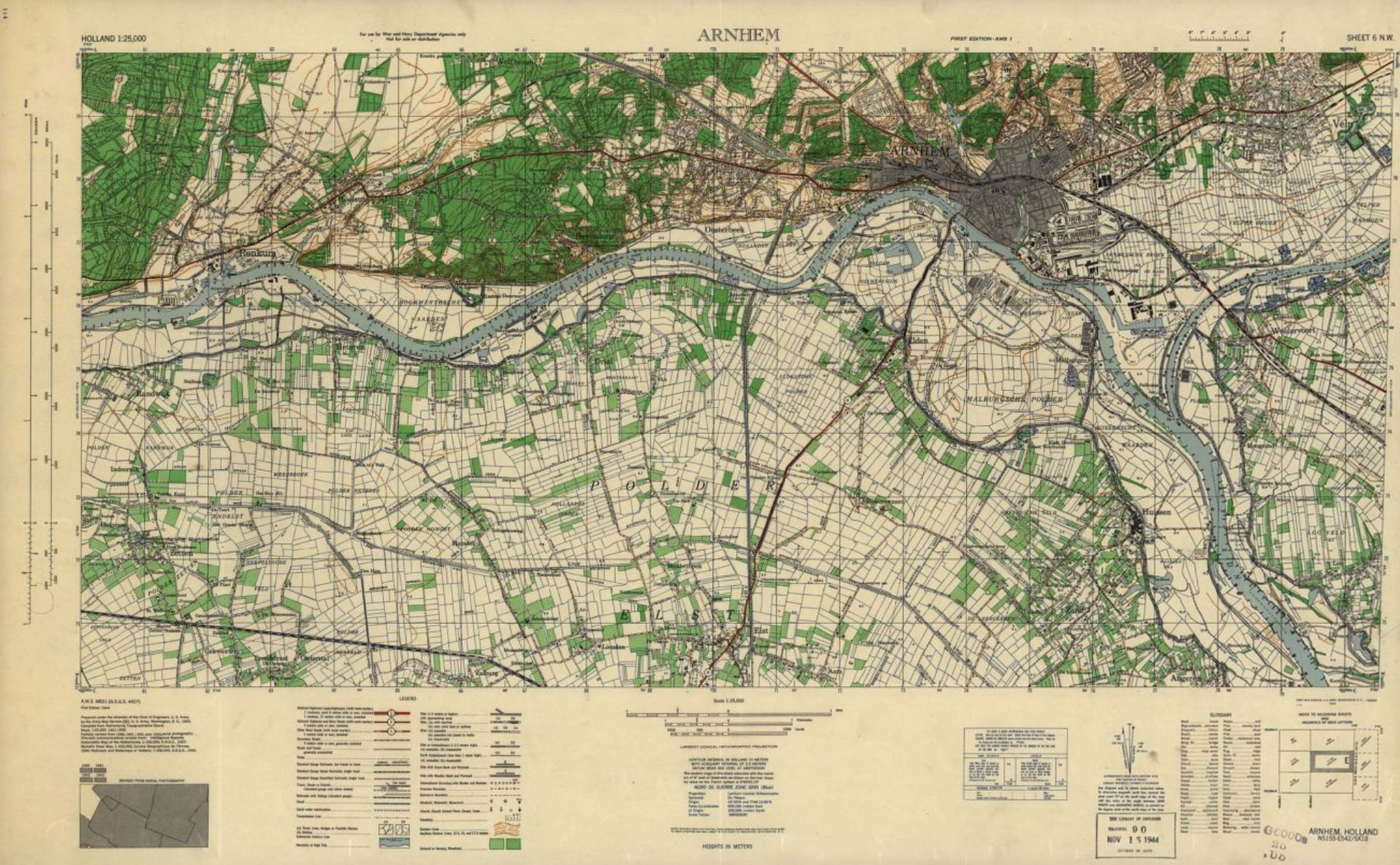
The Battle of Arnhem formed the final and most important phase of Operation Market Garden. The fighting took place in and around the Dutch towns of Arnhem, Oosterbeek, Wolfheze, and Driel between 17 and the night of 25 - 26 September 1944.
The airborne landings
On 17 September 1944, the British 1st Airborne Division landed west of Arnhem with the objective of capturing and holding the Rhine bridge until relieved by advancing British ground forces. However, the airborne troops encountered much stronger German resistance than expected. Unknown to Allied planners, elements of the German 9th SS Panzer Division and 10th SS Panzer Division were refitting near Arnhem after earlier fighting in France.
The British landings were also conducted several kilometers from the bridge itself, forcing airborne troops to advance through difficult terrain while under increasing German attack.
Fighting for the Arnhem bridge
Only a small force led by Lieutenant Colonel John Frost successfully reached the Arnhem road bridge. Frost’s men occupied defensive positions at the northern end of the bridge and resisted repeated German attacks for several days. Meanwhile, the main body of the British 1st Airborne Division became trapped west of Arnhem near Oosterbeek after fierce fighting prevented them from reaching the bridge.
At the same time, the British ground advance led by XXX Corps progressed far more slowly than expected. German resistance, destroyed bridges, traffic congestion, and difficult terrain delayed the Allied advance north toward Arnhem.
Important delays occurred at both Son and Nijmegen, leaving the British airborne forces isolated far longer than originally planned.
The defence of Oosterbeek
After losing control of the Arnhem bridge, the remaining British airborne troops withdrew into a defensive perimeter around Oosterbeek. There they endured constant artillery bombardments, sniper fire, tank attacks, and repeated German assaults. The Polish 1st Independent Parachute Brigade, commanded by Major General Stanisław Sosabowski, landed south of the Rhine near Driel on 21 September 1944. However, poor weather and German control of the river prevented the Poles from significantly reinforcing the trapped British forces.
Attempts by the Royal Air Force to resupply the airborne troops were also heavily disrupted by bad weather and German anti-aircraft fire.
Operation Berlin
After nine days of heavy fighting, Allied commanders concluded that Arnhem could no longer be held. During the night of 25–26 September 1944, surviving troops of the British 1st Airborne Division were evacuated across the Rhine during Operation Berlin. Of the approximately 10.000 men of the British 1st Airborne Division who entered the battle, only around 2.100 escaped back across the river.


Cite this historical page
