---
title: "The Elbe Meeting"
description: "Explore the historic U.S. and Soviet link-up on Elbe Day, April 25, 1945, where regular soldiers met near Torgau to signal the final collapse of the Third Reich."
url: "https://www.normandy1944.info/home/key-events/the-elbe-meeting"
date: "2026-07-18T21:48:39+00:00"
language: "en-GB"
---
# The Elbe Meeting
## April 25, 1945: The historic Allied link-up at Torgau
The handshakes of camaraderie that divided the Third Reich
[](#) [](#)
- [The Elbe Meeting](#)
On **25 April 1945**, American and Soviet troops met on the banks of the **Elbe River** near the German town of **Torgau**, marking one of the final major milestones of the **Second World War** in Europe. Remembered as **Elbe Day**, the historic link-up demonstrated that the remaining territory controlled by **Nazi Germany** had effectively been divided into northern and southern sections. With Allied forces advancing from both east and west, the defeat of the **Third Reich** was now inevitable.
The meeting at the Elbe came after more than **ten months** of relentless Allied advances that began with the **D-Day landings** in **Normandy** on **6 June 1944**. Following the successful invasion of France, the Western Allies liberated **France**, **Belgium** and **Luxembourg**, crossed the **Rhine** and pushed deep into Germany. At the same time, the **Soviet Red Army** advanced westwards after a series of crushing offensives on the Eastern Front, steadily driving German forces back towards **Berlin**. As the distance between the two Allied armies rapidly narrowed, their meeting became inevitable.
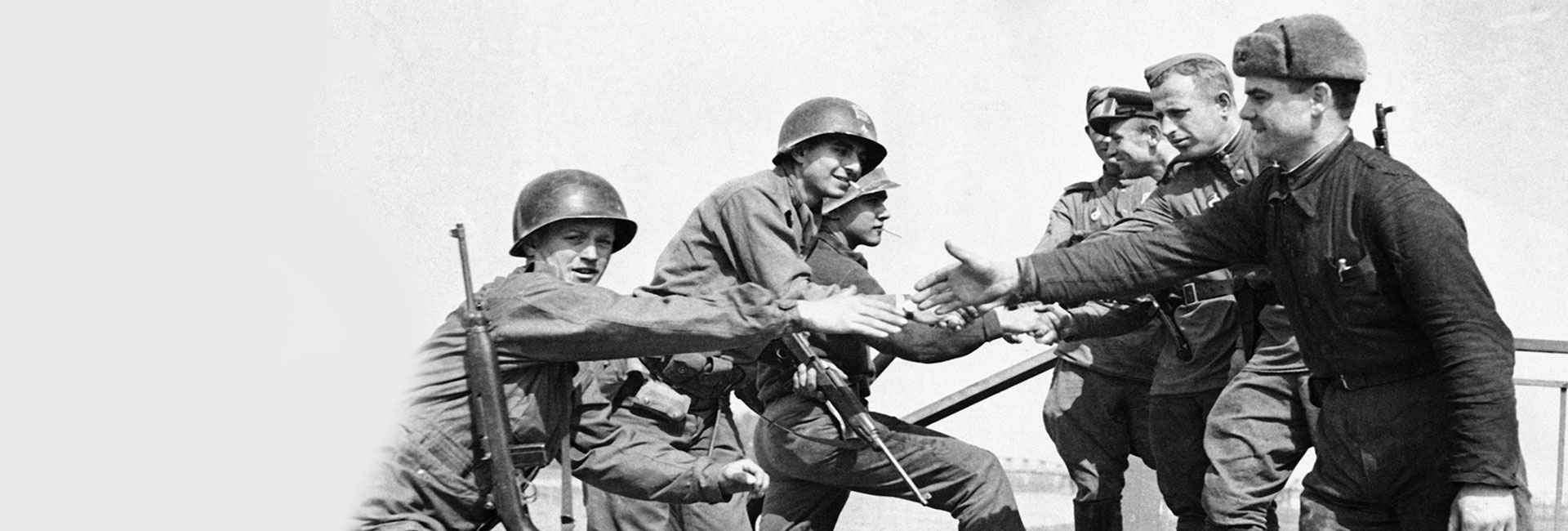
Elbe Day was not a single organised ceremony, but a series of cautious encounters between reconnaissance patrols attempting to locate one another while avoiding accidental clashes. The first documented contact occurred near **Strehla**, where an American patrol led by **First Lieutenant Albert Kotzebue** crossed the Elbe and met Soviet soldiers. Later that afternoon, another American patrol commanded by **Second Lieutenant William Robertson** reached the destroyed bridge at **Torgau**, where they were greeted by a Soviet patrol led by **Lieutenant Alexander Silvashko**. Their meeting became one of the most enduring images of Allied cooperation during the war.
Although the famous handshake photograph was recreated during the following days for military photographers, the relief and friendship displayed by the soldiers were genuine. The encounter soon became known as the **Spirit of the Elbe**, symbolising the successful cooperation between the Western Allies and the **Soviet Union** in the final defeat of **Nazi Germany**.
> Within **five days**, [**Adolf Hitler**](https://www.normandy1944.info/home/commanders/life-and-death-of-adolf-hitler) was dead, and less than **two weeks** later Germany had surrendered unconditionally. Today, Elbe Day remains one of the defining moments of the Allied victory in Europe and one of the final chapters in the campaign that began on the beaches of Normandy.
### Quick Facts
**Date:** **25 April 1945**
**Location:** **Strehla** and **Torgau**, Germany
**Campaign:** Final Allied advance into Germany during the **Second World War**
**Western Allied forces:** **U.S. First Army**, including the **69th Infantry Division**
**Soviet forces:** Elements of the **1st Ukrainian Front**, including the **58th Guards Rifle Division**
**First American patrol:** **First Lieutenant Albert Kotzebue**
**Symbolic meeting:** **Second Lieutenant William Robertson** and **Lieutenant Alexander Silvashko** at **Torgau**
**Senior commanders:** Major General **Emil F. Reinhardt** and Major General **Vladimir Rusakov**
**Result:** American and Soviet forces linked up inside Germany, effectively dividing the remaining territory controlled by the **Third Reich**
**Historical significance:** Demonstrated the imminent collapse of **Nazi Germany** and became a lasting symbol of Allied cooperation known as the **Spirit of the Elbe**.
### The Road to the Elbe
By the spring of **1945**, the defeat of **Nazi Germany** was only a matter of time. In the west, the Western Allies had advanced more than **600 kilometres** from the beaches of **Normandy**, liberated much of Western Europe and crossed the **Rhine**. In the east, the **Soviet Red Army** had driven German forces back through **Poland** and into the heart of Germany. As both offensives gathered momentum, the remaining territory controlled by the **Third Reich** rapidly shrank, making a meeting between the Allied armies inevitable.
Although many American commanders believed they could continue towards **Berlin**, Supreme Allied Commander [**General Dwight D. Eisenhower**](https://www.normandy1944.info/home/commanders/life-and-death-of-dwight-d-eisenhower) decided against such an advance. During the **Yalta Conference** in **February 1945**, the Allied leaders had already agreed upon occupation zones for post-war Germany, placing Berlin within the Soviet zone. Eisenhower therefore saw little military value in sacrificing thousands of Allied lives for a city that would ultimately be occupied by the **Soviet Union**. Instead, the priority became destroying the remaining German armies and establishing contact with Soviet forces.
> At the same time, the Soviet offensive against Berlin gathered pace. Having crossed the **Oder River** and broken through the last major German defensive positions, Marshal **Georgy Zhukov's** **1st Belorussian Front** attacked the German capital from the east, while Marshal **Ivan Konev's** **1st Ukrainian Front** advanced from the south. By **25 April 1945**, Berlin was completely surrounded, leaving the remaining German forces isolated and unable to coordinate any meaningful defence.
### The Strategic Junction
The **Elbe River** formed one of the last major natural barriers in central Germany. By late **April 1945**, American forces advancing from the west and Soviet forces moving from the east were separated by only a few kilometres. Once the two armies linked up, the remaining territory controlled by the Third Reich would be cut into northern and southern sections, preventing German forces from reinforcing one another or organising a coordinated withdrawal.
For the Allies, the meeting represented far more than a symbolic handshake. It confirmed that the military objectives of the Western Allies and the Soviet Union had converged. German formations trapped north of the Elbe could no longer support those fighting in southern Germany or around Berlin. Communications, supply routes and command structures continued to collapse as Allied armies tightened their grip on the remaining German-held territory.
> Despite the approaching victory, commanders on both sides remained cautious. Neither army possessed precise information about the location of every Allied unit, creating the risk of accidental engagements between friendly forces. Reconnaissance patrols therefore moved forward carefully, searching for the opposing Allied army while remaining alert for isolated German units that continued to resist.
### The First Contact at Strehla
The first documented American contact with Soviet forces occurred during the morning of **25 April 1945** near the village of **Strehla**, south of Torgau. **First Lieutenant Albert Kotzebue**, commanding a reconnaissance patrol from the **273rd Infantry Regiment** of the **69th Infantry Division**, reached the western bank of the Elbe and searched for a suitable crossing.
Finding a small boat, Kotzebue crossed the river with three enlisted men. Shortly after landing on the eastern bank, the patrol encountered a Soviet cavalryman attached to a Guards Rifle Regiment commanded by **Lieutenant Colonel Alexander Gordeyev**. The brief meeting confirmed that the two Allied armies had finally reached one another after years of fighting across opposite sides of Europe.
> After exchanging greetings and confirming each other's identity, the patrol returned to report the successful contact. Although historically significant, the encounter at Strehla attracted little immediate publicity and was soon overshadowed by the events that unfolded later that afternoon at nearby Torgau.
### The Meeting at Torgau
Later on **25 April 1945**, another American patrol commanded by **Second Lieutenant William D. Robertson** advanced towards the destroyed bridge spanning the **Elbe River** at **Torgau**. Accompanying Robertson were **Private First Class Frank Huff**, **Private James McDonnell** and **Private Paul Staub**. Across the shattered bridge, the Americans spotted Soviet soldiers from the **58th Guards Rifle Division** commanded by **Lieutenant Alexander Silvashko**. Exercising caution, both patrols approached the broken structure before carefully climbing across the damaged steel girders. Meeting near the centre of the ruined bridge, the soldiers exchanged handshakes, embraces and greetings, celebrating the successful link-up of the Western Allies and the Soviet Union.
> The encounter at Torgau quickly became the best-known moment of Elbe Day. While the first contact had taken place several hours earlier near Strehla, it was the dramatic setting of the destroyed bridge, together with the presence of senior officers and photographers during the following days, that transformed Torgau into one of the enduring symbols of Allied victory in Europe.
### The Handshake That Became History
The encounters at **Strehla** and **Torgau** on **25 April 1945** took place between small forward patrols. No official photographers were present to record the first moments when American and Soviet soldiers met. Once news of the historic link-up reached senior commanders, arrangements were made to document and publicise the event. During the following days, American and Soviet soldiers returned to the damaged bridge at Torgau and recreated their meeting for military photographers and newsreel cameramen. The best-known photographs show **Second Lieutenant William Robertson** and **Lieutenant Alexander Silvashko** smiling, embracing and shaking hands beneath a sign proclaiming that east had met west.
Although these photographs did not capture the actual moment of first contact, they accurately reflected the relief and excitement experienced by the soldiers. The Western Allies and the Soviet Red Army had fought towards one another across a continent devastated by almost **six years** of war. Their meeting provided visible proof that the remaining territory of Nazi Germany had been cut apart.
> The photographs were distributed around the world and transformed the meeting at Torgau into the defining image of **Elbe Day**. The earlier encounter near Strehla remained historically important as the first documented contact, but the dramatic setting of the ruined bridge ensured that Torgau became permanently associated with the event.
### The Official Commanders’ Meeting
Following the spontaneous encounters between the patrols, a formal meeting was arranged between senior American and Soviet officers. On **26 April 1945**, Major General **Emil F. Reinhardt**, commander of the U.S. **69th Infantry Division**, met Major General **Vladimir Rusakov**, commander of the Soviet **58th Guards Rifle Division**. The two commanders exchanged greetings and formally recognised the junction of their divisions. Their meeting confirmed at command level what the forward patrols had already achieved along the Elbe: the Western Allied and Soviet fronts had finally joined inside Germany.
Officers also exchanged information about the positions of their units. This coordination was essential because both armies were advancing across a rapidly changing battlefield. Isolated German formations were still surrendering, retreating or attempting to escape, while American and Soviet units risked accidentally entering one another’s areas of operation.
> On **27 April 1945**, the governments of the **United States**, the **United Kingdom** and the **Soviet Union** publicly announced that their armies had joined in the heart of Germany. The announcement presented the meeting as unmistakable evidence that the destruction of the Third Reich was nearing completion.
### Germany Cut in Two
The meeting at the Elbe was more than a symbolic demonstration of Allied unity. It confirmed that the territory still controlled by Nazi Germany had effectively been divided into northern and southern sections. German formations in the north could no longer maintain reliable contact with forces fighting in southern Germany, Austria, Czechoslovakia or around Berlin. By late **April 1945**, Germany’s military organisation was disintegrating. Railways, bridges and roads had been destroyed or captured, communications were unreliable and fuel supplies were critically low. The German High Command could no longer move large formations freely or establish a continuous defensive front between the advancing Allied armies.
> Large numbers of German soldiers and civilians were also moving westwards. Many hoped to enter territory occupied by American or British troops rather than fall into Soviet captivity. These movements added to the chaos on Germany’s roads and further weakened attempts to organise continued resistance.
The link-up did not immediately end the fighting. German troops continued to resist in Berlin, northern Germany, Czechoslovakia, Austria and several isolated pockets. Nevertheless, Elbe Day confirmed that Nazi Germany no longer possessed the territory, resources or freedom of movement required to continue the war as a coordinated military campaign.
### The Final Collapse of Nazi Germany
On the same day that American and Soviet soldiers met at the Elbe, Soviet forces completed the encirclement of **Berlin**. The German capital was already under heavy artillery fire, and Soviet troops were fighting their way through the outer districts towards the government centre. Inside the **Führerbunker** beneath the Reich Chancellery, **Adolf Hitler** continued to issue orders to formations that had either been destroyed or no longer possessed the strength to carry them out. The meeting at the Elbe demonstrated that any remaining hope of separating the Western Allies from the Soviet Union or reversing the military situation had disappeared.
On **30 April 1945**, only **five days** after Elbe Day, Hitler committed suicide. Before his death, he appointed Grand Admiral [**Karl Dönitz**](https://www.normandy1944.info/home/commanders/life-and-death-of-karl-doenitz) as President of Germany. Dönitz established a new government in northern Germany and attempted to surrender German forces to the Western Allies while continuing to resist the Soviet advance. The Western Allies refused to accept a surrender limited to the western front and insisted upon the unconditional surrender of all German armed forces. On **2 May 1945**, the remaining defenders of Berlin surrendered to the Red Army.
> On **7 May 1945**, Generaloberst **Alfred Jodl** signed the unconditional surrender of Germany’s armed forces at **Reims** in France. The surrender came into effect on **8 May 1945**, bringing the Second World War in Europe to an end.
A further signing took place at **Berlin-Karlshorst** during the night of **8–9 May 1945**. Field Marshal **Wilhelm Keitel** signed on behalf of the German High Command in the presence of senior Soviet and Western Allied representatives.
### The Human Side of Elbe Day
For the soldiers who met along the Elbe, the occasion represented far more than a strategic military achievement. Many had spent years fighting through ruined towns, devastated countryside and heavily defended positions. The sight of an allied army approaching from the opposite direction offered unmistakable evidence that the war was finally nearing its end. American and Soviet soldiers greeted one another with handshakes, embraces and broad smiles. Few spoke the same language, but they communicated through gestures, interpreters and the exchange of small personal possessions. Cigarettes, badges, uniform buttons, watches and other souvenirs passed between men who had travelled across Europe from opposite directions.
Food and drink were shared wherever they were available, while soldiers posed together for photographs and attempted to learn one another’s names. After years of combat, these encounters represented victory, survival and the possibility that they might soon return home. The celebrations did not erase the enormous political and cultural differences between the two armies. Nor did they remove the distrust already present among their governments.
> At the level of the ordinary soldier, however, Elbe Day produced a genuine moment of companionship between men who recognised that they had fought against the same enemy.
### The Spirit of the Elbe
The expression **Spirit of the Elbe** came to represent the cooperation and friendship associated with the meeting of American and Soviet troops. It reflected the belief that nations with profoundly different political, economic and social systems had been able to unite for the common purpose of defeating Nazi Germany. For many of the veterans, the meaning of Elbe Day extended beyond military victory. They regarded their meeting as evidence that cooperation between the United States and the Soviet Union was possible, even when their governments disagreed. Some spent much of their later lives preserving the memory of the encounter and presenting it as a symbol of peace.
One of the most committed was American veteran **Joseph Polowsky**, who had accompanied the patrol led by Albert Kotzebue. Polowsky later campaigned for **25 April** to be recognised internationally as a day of peace. In accordance with his final wishes, he was buried in Torgau after his death in **1983**. The Spirit of the Elbe acquired even greater significance because the political unity displayed in April 1945 proved so brief. Within only a few years, the wartime allies had become rivals in a global political, military and ideological confrontation.
### From Wartime Alliance to Cold War
The alliance between the Western powers and the Soviet Union had been created by the shared necessity of defeating Nazi Germany. Even before the war ended, serious disagreements existed over the political future of Europe, the treatment of Germany and Soviet control over territories occupied by the Red Army. After Germany’s surrender, the occupation zones agreed by the Allies formed the basis of a divided country. In **1949**, the American, British and French zones became the **Federal Republic of Germany**, commonly known as West Germany. The Soviet occupation zone became the **German Democratic Republic**, or East Germany.
The Elbe did not become the permanent boundary between the emerging political blocs. Nevertheless, the meeting there came to symbolise the point at which the great military advances from east and west converged before the former allies began to move apart politically.
> The handshakes at Torgau were soon overshadowed by disputes over Eastern Europe, the **Berlin Blockade**, the formation of opposing military alliances and the growing threat of nuclear conflict. Veterans from both armies nevertheless continued to commemorate their meeting and preserve friendships formed during the final days of the war.
### The Legacy of Elbe Day
Elbe Day has never achieved the same international prominence as D-Day, the fall of Berlin or Victory in Europe Day. Its historical importance, however, remains considerable. The meeting confirmed that the Allied armies advancing from east and west had completed the military division of Nazi Germany. Memorials in and around **Torgau**, **Strehla** and other locations along the Elbe commemorate the encounters of **25 April 1945**. Anniversary ceremonies have brought together veterans, soldiers, political representatives and members of the public to remember both the defeat of Nazi Germany and the brief moment of Allied unity.
The famous photographs taken at Torgau remain among the defining images of the final days of the Second World War in Europe. Although the scenes were recreated for the cameras, they did not invent the meaning of the event. They gave visible form to a genuine military achievement and to the relief felt by soldiers who understood that the end of the war was near. For the Western Allies, Elbe Day was one of the final milestones in a campaign that had begun on the beaches of Normandy more than **ten months** earlier.
> For the Soviet Union, it marked the culmination of an advance that had carried the Red Army from the battles before Moscow and Stalingrad into the heart of Germany. For Europe, the meeting demonstrated that the Third Reich had been crushed between the Allied armies and had only days left to exist.
### Principal Figure
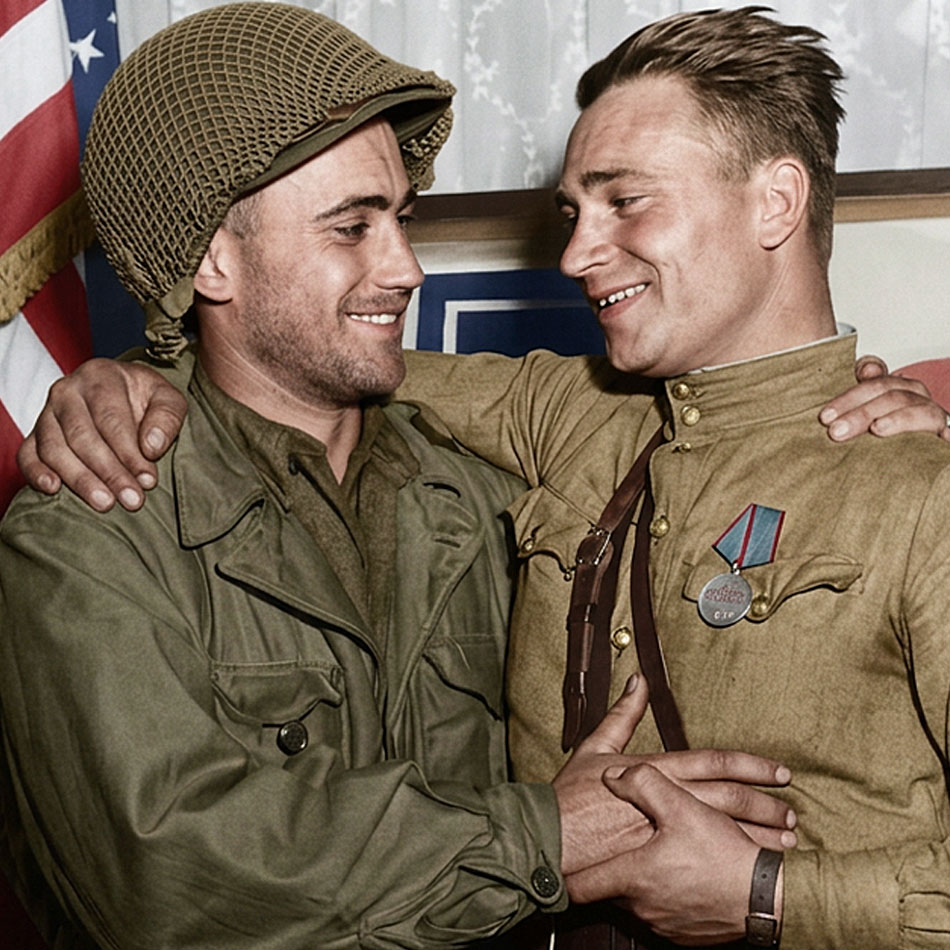U.S. 2nd Lieutenant William Robertson and Lt. Alexander Sylvashko, Russian Army, in front of sign "East Meets West" symbolizing historic meeting of Russian and American Armies, near Torgau, Germany
[](#)
[](#)
### Location
 OpenStreetMap service required
to load this map.
OpenStreetMap service required
to load this map.
### Explore More
Explore more about the people, organisations and events connected to Elbe Meeting
- [Adolf Hitler](https://www.normandy1944.info/home/commanders/life-and-death-of-adolf-hitler)
- [Dwight D. Eisenhower](https://www.normandy1944.info/Dwight%20D.%20Eisenhower)
- [Georgy Zhukov](https://www.normandy1944.info/Georgy%20Zhukov)
- [World War II Timeline](https://www.normandy1944.info/home/timeline)
The names and events are clickable.
---
### Did you know
**The first American-Soviet contact did not take place at Torgau.** The earliest documented meeting occurred near **Strehla** on **25 April 1945**, when a patrol led by **First Lieutenant Albert Kotzebue** crossed the Elbe and encountered Soviet troops. Torgau became the internationally recognised symbol of Elbe Day because the later meeting there was photographed against the dramatic background of the destroyed bridge.
[](#)
[](#)
The Elbe Meeting the real story
### The Elbe Meeting photographs
Click the images to enlarge them
[ 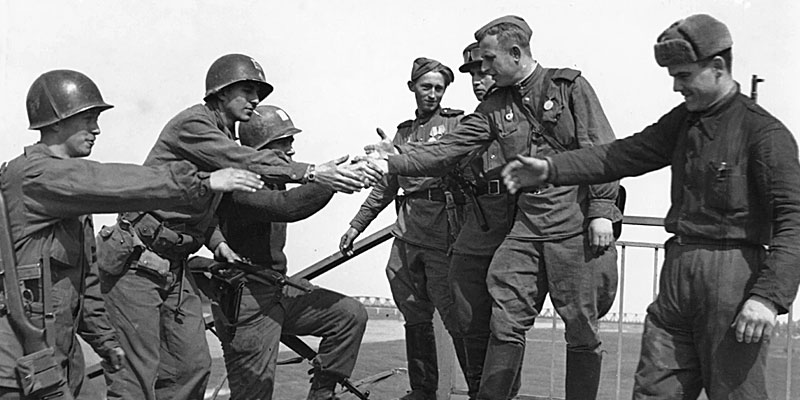
Crossing the Ruined Bridge: American and Soviet soldiers meet at the Torgau bridge to exchange handshakes, creating one of the war's most iconic images of allied unity.
Read more
](https://www.normandy1944.info/images/keyevents/elbe_meeting/Meeting_on_the_broken_girders.jpg)
[ 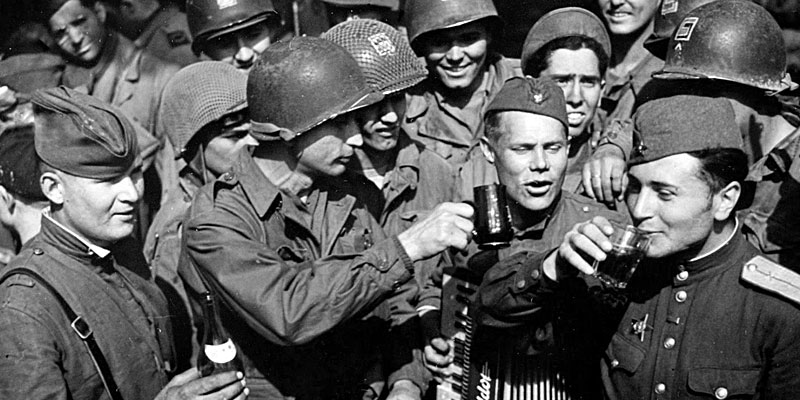
Celebrating Survival: American and Soviet soldiers toast their historic junction during a spontaneous celebration.
Read more
](https://www.normandy1944.info/images/keyevents/elbe_meeting/Celebration_toast_with_accordion.jpg)
[ 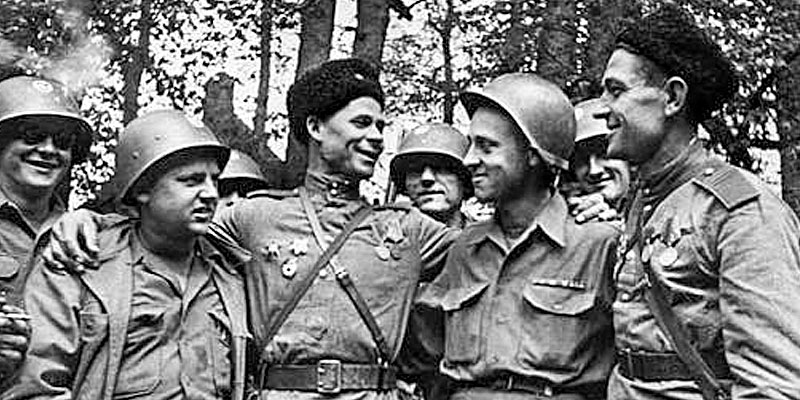
Front-Line Companionship: American and Soviet infantrymen stand shoulder-to-shoulder near the elbe
Read more
](https://www.normandy1944.info/images/keyevents/elbe_meeting/Soldiers_standing_in_a_line_arms_around_shoulders.jpg)
[ 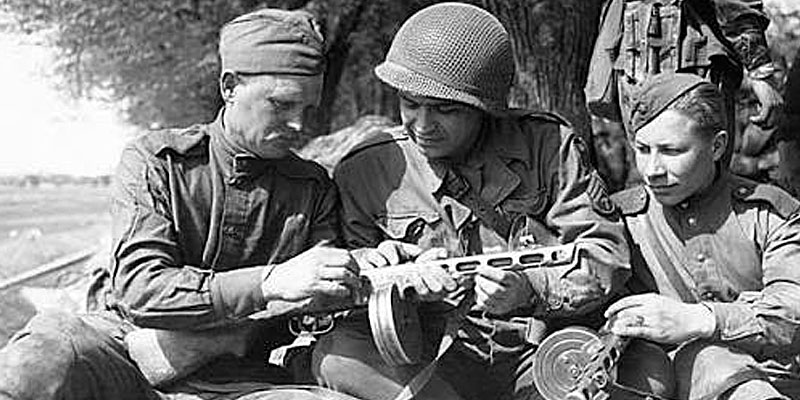
An American sergeant and Soviet soldiers closely examine a Soviet PPSH-41 submachine gun.
Read more
](https://www.normandy1944.info/images/keyevents/elbe_meeting/Examining_the_drum_magazine_weapon.jpg)
[ 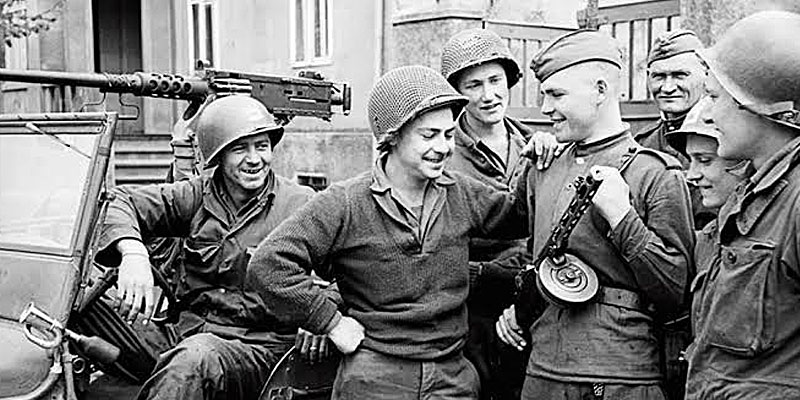
American troops relax alongside their soviet counterparts around a US Army jeep. These moments highlighted the shared humanity of the men on the ground.
Read more
](https://www.normandy1944.info/images/keyevents/elbe_meeting/Soldiers_gathered_around_a_jeep.jpg)
[ 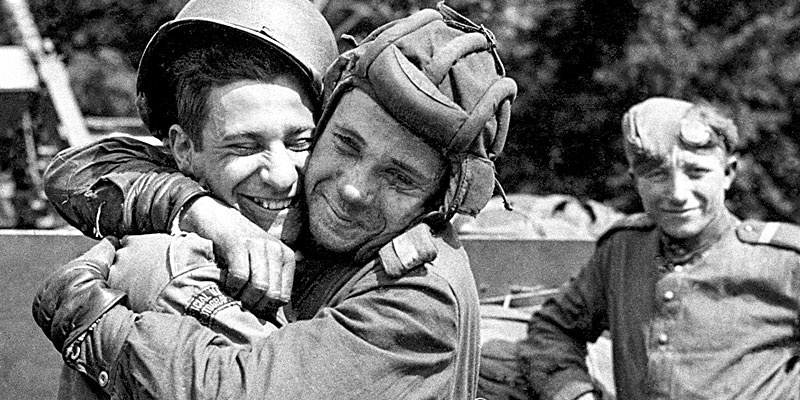
American soldier and a Soviet tanker share a joyful embrace following the link-up, hoping that the war in Europe neared its end.
Read more
](https://www.normandy1944.info/images/keyevents/elbe_meeting/Embrace_by_the_tank.jpg)
[ 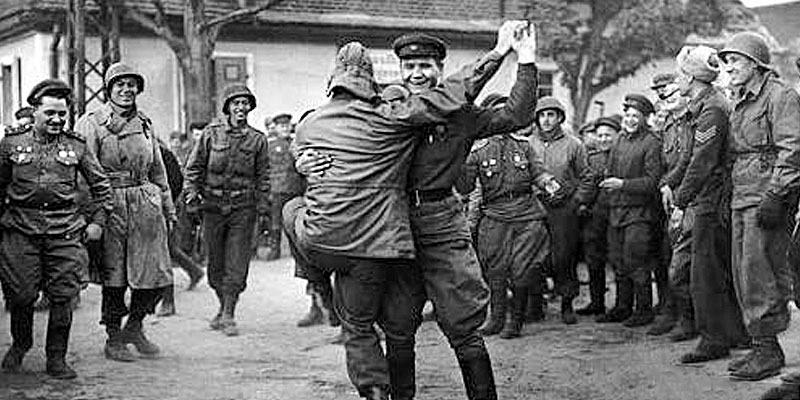
Soviet and American soldiers dance together in a village street near the river.
Read more
](https://www.normandy1944.info/images/keyevents/elbe_meeting/Dancing_in_the_street.jpg)
[ 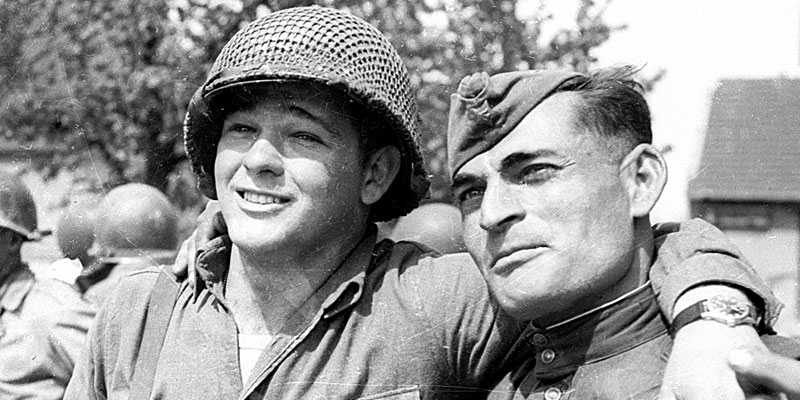
US private first class John A. Vega (left) from the 69th Infantry Division alongside Soviet Red Army senior sergeant Grigory Yashin.
Read more
](https://www.normandy1944.info/images/keyevents/elbe_meeting/US_and_Soviet_friends_for_life.jpg)
[ 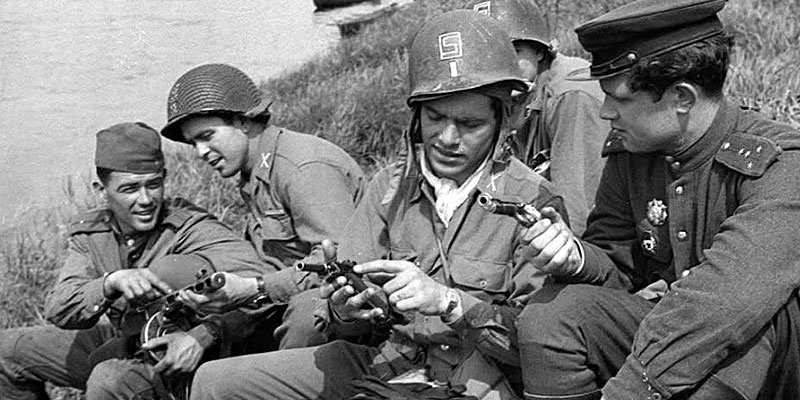
Examining and comparing each other's service pistols and sidearms in a moment of relaxed curiosity.
Read more
](https://www.normandy1944.info/images/keyevents/elbe_meeting/American_and_Soviet_soldiers_sit_together_on_the_banks_of_the_Elbe_river.jpg)
### The Elbe Meeting key dates
**6 June 1944:** The **D-Day landings** begin the Allied liberation of Western Europe from **Normandy**.
**25 April 1945 (11:30): First Lieutenant Albert Kotzebue** leads the first documented American patrol to make contact with Soviet troops near **Strehla**.
**25 April 1945 (15:30): Second Lieutenant William Robertson** and **Lieutenant Alexander Silvashko** meet on the destroyed bridge at **Torgau**, creating the historic link-up remembered as **Elbe Day**.
**26 April 1945:** Major General **Emil F. Reinhardt** and Major General **Vladimir Rusakov** hold the first official meeting between American and Soviet commanders.
**26–27 April 1945:** Military photographers recreate the famous **Handshake of Torgau**, producing one of the most recognisable images of the **Second World War**.
**30 April 1945:Adolf Hitler** commits suicide in the **Führerbunker** beneath the **Reich Chancellery** in **Berlin**.
**2 May 1945:** German forces defending **Berlin** surrender to the **Soviet Red Army**.
**7 May 1945:** Germany signs the **Instrument of Unconditional Surrender** at **Reims**, France.
**8 May 1945:** Germany's unconditional surrender comes into effect, celebrated as **Victory in Europe (VE) Day** across Western Europe.
**8–9 May 1945:** A second surrender ceremony is held at **Berlin-Karlshorst**, where Field Marshal **Wilhelm Keitel** signs on behalf of the German High Command, forming the basis of **Victory Day** commemorations in the former **Soviet Union**.
The Elbe Meeting key dates
### The Elbe Meeting conclusion
On **25 April 1945**, American and Soviet soldiers meeting along the Elbe River witnessed one of the defining moments of the final campaign against Nazi Germany. The encounters near **Strehla** and **Torgau** confirmed that the great Allied advances from west and east had finally joined inside the heart of the Third Reich. The meeting carried immediate military importance. Germany’s remaining territory had been effectively divided, its armies were isolated from one another and its transport, communications and command structures were collapsing. Berlin was surrounded, and any realistic possibility of prolonging the war through a coordinated national defence had disappeared.
Yet the lasting importance of Elbe Day extends beyond strategy and military geography. The handshakes, embraces and exchanges between ordinary American and Soviet soldiers captured the relief of men who understood that years of fighting were approaching their end. They had travelled towards one another across a devastated continent and had finally met after helping to destroy a regime responsible for war, occupation, persecution and mass murder across Europe. The unity represented at Torgau did not last. Within a few years, the former allies were divided by the **Cold War**, Germany had been separated into eastern and western states and Europe had become the centre of a new global confrontation. This later division gave the memory of the meeting even greater meaning. The **Spirit of the Elbe** became a reminder that cooperation had once been possible despite profound political differences.
For the Western Allies, Elbe Day marked one of the final chapters of the campaign that had begun on the beaches of **Normandy** on **6 June 1944**. For the Soviet Union, it represented the culmination of an immense westward advance achieved at enormous human cost. For Nazi Germany, the meeting confirmed that the end had arrived.
> Only **five days** later, [**Adolf Hitler**](https://www.normandy1944.info/home/commanders/life-and-death-of-adolf-hitler) was dead. Less than **two weeks** after the link-up, Germany surrendered unconditionally. The photographs taken at Torgau continue to preserve that brief and extraordinary moment when east met west, the Third Reich was crushed between the Allied armies and the end of the Second World War in Europe finally came into view.
Crossing the Ruined Bridge: American and Soviet soldiers meet at the Torgau bridge to exchange handshakes, creating one of the war's most iconic images of allied unity.
[](#)
[](#)
Conclusion
### The Elbe Meeting | FAQ & Historical Facts
What was Elbe Day? Elbe Day was the meeting of American and Soviet troops along the Elbe River in Germany on 25 April 1945. The link-up confirmed that the Allied armies advancing from east and west had effectively divided the remaining territory controlled by Nazi Germany
Where did American and Soviet forces first meet? The first documented contact took place near Strehla, south of Torgau. An American patrol led by First Lieutenant Albert Kotzebue crossed the Elbe and encountered Soviet troops during the morning of 25 April 1945.
Why is Torgau associated with Elbe Day? Although the first documented contact occurred near Strehla, the later meeting at Torgau became internationally famous. The damaged bridge across the Elbe provided a dramatic setting for photographs of American and Soviet soldiers greeting one another.
Who were William Robertson and Alexander Silvashko? Second Lieutenant William Robertson was an American officer serving with the U.S. 69th Infantry Division. Lieutenant Alexander Silvashko was a Soviet officer serving with the 58th Guards Rifle Division. Their meeting at Torgau became the best-known encounter of Elbe Day.
Was the famous handshake photograph staged? The famous photographs were arranged after the initial meeting because no official photographers had been present during the first contact. Robertson, Silvashko and other soldiers recreated their greetings for military photographers and newsreel cameramen. Although the scenes were reconstructed, the meeting itself and the soldiers’ relief were genuine.
Why did the Western Allies not advance on Berlin? Supreme Allied Commander General Dwight D. Eisenhower decided that capturing Berlin was not essential to the Western Allied military plan. The city lay deep inside the occupation zone allocated to the Soviet Union, and Eisenhower wished to avoid the heavy casualties expected in an assault on the German capital. His priority was the destruction of remaining German forces and contact with the Red Army.
How soon did Germany surrender after Elbe Day? Germany signed its unconditional military surrender at Reims on 7 May 1945. The surrender came into effect on 8 May 1945, less than two weeks after Elbe Day. A further signing took place at Berlin-Karlshorst during the night of 8–9 May.
#### Cite this historical page
I aim to provide accurate, open-access accurate historical records. If you are using this content for academic research, articles or educational projects, please use the citation below to credit this source. Click the button below to copy the direct URL for your research or citations.

## Schema
```json
{ "@context": "https://schema.org", "@type": "Article", "mainEntityOfPage": { "@type": "WebPage", "@id": "https://www.normandy1944.info/home/key-events/the-elbe-meeting" }, "headline": "The Elbe Meeting", "description": "Explore the historic U.S. and Soviet link-up on Elbe Day, April 25, 1945, where regular soldiers met near Torgau to signal the final collapse of the Third Reich.", "image": { "@type": "ImageObject", "url": "https://www.normandy1944.info/images/keyevents/elbe_meeting/The-Elbe-meeting-april-1945.jpg" }, "publisher": { "@type": "Organization", "name": "Normandy1944.info – D-Day, Normandy and Beyond", "logo": { "@type": "ImageObject", "url": "https://www.normandy1944.info/images/logo/D-Day-Normandy-1944-WW2-logo.png" } }, "author": { "@type": "Person", "name": "Frank C. Everards", "url": "https://www.normandy1944.info/blog/how-it-started" }, "datePublished": "2026-07-18T17:18:38+02:00", "dateCreated": "2026-07-18T17:18:38+02:00", "dateModified": "2026-07-18T19:25:48+02:00" }
```